Women's Winter Cashmere Scarves: A Consumer Research Brief
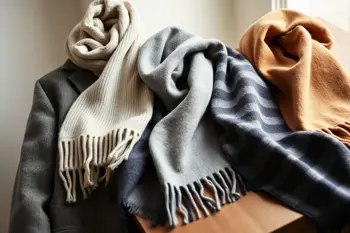
Women’s winter cashmere scarves are commonly presented as soft, lightweight accessories that provide warmth without the bulk associated with heavier winter layers. The category includes pure cashmere, wool-cashmere blends, cashmere-silk constructions, oversized wraps, ribbed knits, and artistic printed shawls, with substantial differences in dimensions, care instructions, sourcing information, and documented prices.
What defines a cashmere winter scarf
Cashmere is a natural fiber taken from the undercoat of cashmere goats. Its structure provides insulation while remaining lightweight and breathable, which explains its use in accessories intended for both outdoor cold and indoor wear. Mongolian and Inner Mongolian fibers are especially prominent in the category because goats in those regions develop undercoats suited to severe climates. Fiber diameter and length are important indicators of softness, durability, and resistance to surface wear. 1
Product descriptions show that “cashmere scarf” does not indicate one uniform format. WoolOvers documents a 100% cashmere scarf measuring 166 by 33 centimeters, while Quince lists a 100% Grade-A Mongolian cashmere scarf at 10 by 70 inches. A US Cashmere example is a long knitted design measuring 30 by 180 centimeters. These dimensions affect whether a scarf works primarily as a neck wrap, a layered stole, or an oversized shoulder covering. 2
Fiber grades and construction
Grade A cashmere is generally associated with fibers measuring approximately 14 to 15.5 microns in diameter. Finer fibers tend to create a softer hand feel, although softness alone does not establish overall quality. Fiber length, yarn processing, finishing, and knitting or weaving technique also influence shedding, durability, and pilling. Quince specifies a 15.8 to 16.2 micron thickness, a 12-gauge construction, and 34 to 36 millimeter fiber length for one documented scarf. 3
Ply count is another construction measure used in cashmere assessment. Two-ply yarn is often described as a standard approach for balancing warmth, resilience, and shape retention in winter accessories. However, the supplied product records do not provide ply counts for the listed scarves, so construction claims should not be inferred from fiber content alone. A label stating 100% cashmere establishes composition, but not necessarily weight, density, ply, or finishing quality. 4
Formats, proportions, and styling function
Rectangular scarves dominate the documented examples, but their proportions vary considerably. The WoolOvers model is 166 centimeters long and 33 centimeters wide, the US Cashmere model is 180 by 30 centimeters, and the Quince model is 70 inches long and 10 inches wide. Longer formats permit repeated wrapping and layering, while narrower designs can create a less bulky profile beneath a coat collar. 5
Specialized formats expand beyond the conventional rectangle. Akris records a 65 by 200 centimeter printed cashmere scarf, and Gabriela Hearst describes a 100% cashmere knitted wrap with a 78-inch base and 44-inch sides. Issey Miyake documents a cashmere-silk muffler with multiple holes that can be worn around the neck or arranged over the arms like a bolero. These examples demonstrate that winter cashmere accessories may function as scarves, shawls, wraps, or garment-like layers. 6
Pure cashmere versus blended materials
Material labels are central to comparing women’s winter scarves. Pure cashmere examples in the research include WoolOvers, US Cashmere, Quince, Akris, and Gabriela Hearst. A separate Veronica Beard design is described as a merino wool-cashmere blend, while Gilardoni Como lists a triangular scarf composed of 70% wool and 30% cashmere. Issey Miyake specifies a 50% cashmere and 50% silk composition. 7
Blends can change texture, structure, weight, and care requirements, so “cashmere” in a product title should not be treated as proof of a pure-fiber garment. Wool may provide a firmer hand and greater structure, while silk can produce a smoother, lighter surface, but the supplied records do not provide controlled performance comparisons. The appropriate evaluation therefore begins with the composition label, followed by dimensions, construction details, and the stated care method. 8
Care, pilling, and practical limitations
Cashmere requires deliberate maintenance because friction, heat, moisture, and unsuitable detergents can damage delicate fibers. Hand washing with cold water and a neutral soap or baby shampoo is specified for the Quince scarf, which should be rinsed without rubbing and laid flat away from sunlight. Nordstrom’s cited care guidance also identifies hand washing as a method for preserving fiber integrity, while some luxury products specify dry cleaning instead. 9
Pilling is a natural result of fiber friction and does not automatically demonstrate defective material. It commonly appears where a scarf rubs against a coat, bag strap, or other layers. A dedicated cashmere comb or fabric shaver can remove pills, but aggressive treatment may pull or weaken yarns. Care labels remain decisive because instructions differ by construction. Issey Miyake’s listed item says not to wash or wet-clean and instead specifies a restricted dry-cleaning process. 10
Sourcing, sustainability, and market context
Sourcing information varies widely across the category. Quince identifies Inner Mongolia as the origin of its cashmere and states that production occurs in BSCI-certified factories in China and Cambodia. The Good Cashmere Standard focuses on animal welfare, herder livelihoods, and responsible land management. Sustainability analysis also recognizes grazing pressure on grassland ecosystems, making traceability and land stewardship relevant considerations beyond fiber softness. 11
Documented prices span a broad luxury and contemporary range, but they should be read as individual listing records rather than a current market index. The research includes Quince at 54 US dollars, US Cashmere at 69 dollars, WoolOvers at 185 dollars, Akris at 795 euros, Sabina Savage at 1,000 dollars, and Gabriela Hearst at 2,990 dollars. Differences may reflect fiber purity, design authorship, dimensions, production method, branding, and artistic treatment. 12
Comparison checklist for winter use
A practical comparison should separate measurable specifications from aesthetic language. “Soft,” “luxurious,” and “timeless” describe positioning, but they do not replace composition, dimensions, fiber measurements, or care instructions. The following points are supported by the documented category data and help identify meaningful differences between scarves:
- Composition: verify whether the item is pure cashmere or a wool-cashmere or cashmere-silk blend.
- Dimensions: compare length and width with the intended wrapping or layering method.
- Construction: look for gauge, ply, fiber length, or knit and weave information when supplied.
- Maintenance: check whether hand washing, dry cleaning, or avoidance of wet cleaning is required.
- Sourcing: review stated fiber origin, factory information, animal welfare, and land-management standards.
- Wear expectations: recognize that pilling can occur through friction and requires gentle removal.
The principal trade-off is between softness, warmth, design complexity, maintenance, and cost. A pure cashmere rectangle may prioritize easy layering, while a printed collector’s scarf or hand-knitted wrap may emphasize artistic value and larger proportions. A blend may offer a different structure or surface feel, but composition must be considered before comparing prices or care burdens. No single specification establishes superior performance across every winter setting.
Sources
- MasterClass, What Is Cashmere
- WoolOvers, Pure Cashmere Scarf
- Quince, Mongolian Cashmere Scarf
- Naadam, What Is Cashmere
- US Cashmere, Luxury Cashmere Long Scarf for Women
- Akris, Cashmere Scarf with Fuchsie Print
- Veronica Beard, Wool-Cashmere Scarf
- Gilardoni Como, Marella Triangular Scarf
- Nordstrom, How to Wash Cashmere
- Harper’s Bazaar, Cashmere Care
- The Good Cashmere Standard
- Gabriela Hearst, Lauren Knit Wrap
Authored by MyTrendSpot team