7-day Mediterranean cruises through Greek islands and protected nature reserves: An Evidence-Based Itinerary Guide
Seven-day Mediterranean cruises through Greek islands and protected nature reserves combine island travel with access to historic sites, marine parks, geological landscapes, and coastal villages. Documented itineraries range from large-ship Greek Isles routes to small-yacht voyages serving the Sporades, Cyclades, Peloponnese, and nearby Turkish coast. The central distinction is whether a voyage is designed mainly around major ports or around lower-impact access to sensitive natural areas.
What a seven-day Greek island itinerary usually includes
Week-long routes commonly begin or end at Athens, usually through Piraeus or nearby Lavrion. A documented PONANT itinerary from Athens runs for seven nights and includes Patmos, Amorgos, Milos, Hydra, and Çeşme, with fares reported from £4,250 per person. Its route combines Greek and Turkish ports rather than concentrating exclusively on the Cyclades. 1
Other routes use a broader eastern Mediterranean pattern. Azamara’s seven-night sailing from Athens lists Ermoupoli on Syros, Patmos, Rhodes, Marmaris, Santorini, and additional calls, while another PONANT itinerary travels from Athens toward Alexandria with Santorini, Heraklion, Rhodes, Nafplion, and Antalya. These examples show that “Greek Isles” may describe substantially different geographic combinations. 4 5
Small-ship access to protected landscapes
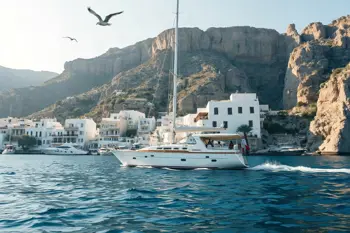
Small vessels are particularly relevant to nature-focused cruising because boutique itineraries can reach islands and coves that are not practical for large-scale cruise ships. Elixir Cruises describes an eight-day voyage aboard The Elysium linking Edipsos, Oreoi, Volos, Skiathos, Skopelos, Alonissos, Skyros, Andros, and Kea. Activities listed include snorkeling, swimming, guided walks, and visits to marine parks. 2
The Alonissos Marine Park in the Northern Sporades is identified in the research material as a protected area associated with Mediterranean monk seal conservation. Such locations require a different visitor model from a conventional city-port call. Shore activities may depend on weather, docking conditions, local rules, and the captain’s safety decisions, all of which can alter the published sequence. 2 10
Nature reserves, heritage sites, and protected waters
Nature and heritage interests frequently overlap in Greek island cruising. PONANT identifies Delos and Patmos as UNESCO World Heritage sites within an Aegean itinerary and also describes sailing in the Santorini caldera, swimming in small coves, and visiting Çeşme, a Turkish port known for natural hot springs. These experiences combine archaeological significance with coastal and geological features. 8
Research supplied for this topic also identifies Zakynthos National Marine Park as a protected area associated with Greek island itineraries. Marine protected areas are managed to preserve biodiversity, and guidance from UNESCO, Visit Greece, and MedPAN is relevant to understanding conservation and visitor-management principles. A port visit should not be interpreted as unrestricted access to every beach, breeding zone, anchorage, or marine habitat. 12 13 14
Comparing large ships and expedition yachts
Large cruise ships generally provide more onboard facilities and a higher passenger capacity, but their routes tend to emphasize established ports. Holland America’s seven-day Greek Isles material highlights entertainment, dining, lounges, fitness facilities, a casino, and organized onboard activities, illustrating the ship-centered structure common to mainstream cruising. 3
Expedition-style yachts place greater emphasis on destination access and shore time. A reported Virgin Voyages itinerary carries 2,770 passengers and 1,150 crew and visits Athens, Kotor, Dubrovnik, Corfu, and Mykonos, while a PONANT voyage uses a much smaller yacht format for Greek and Turkish calls. These differences affect docking choices, excursion scale, environmental pressure, and the likelihood of visiting smaller harbors. 6 1
Seasonality, scheduling, and itinerary uncertainty
The research material identifies May and June, together with September and October, as favorable periods for nature-focused Mediterranean cruising because they generally avoid the most intense summer congestion and heat. July and August remain prominent in published Greek island schedules, including Elixir’s July 2027 departure through the Sporades and Cyclades, but seasonal conditions can influence swimming, hiking, and time ashore. 2 14
Published schedules are not absolute operating guarantees. Elixir states that itineraries may change because of weather, docking difficulties, or unforeseen circumstances, with decisions made by the captain for passenger, crew, and vessel safety. This is particularly important around exposed islands, small anchorages, protected coastlines, and ports where tendering or local access is required. 2
Environmental oversight and practical limitations
Environmental management is a defining issue for cruising near protected reserves. The supplied research identifies Greek regulatory requirements concerning passenger disembarkation in sensitive ecological zones, while CLIA is cited as an industry source for environmental compliance monitoring. Shore-power adoption is also described as an emerging measure intended to reduce emissions while vessels are docked, although implementation depends on port infrastructure and ship capability. 15 16
Travelers assessing an itinerary should distinguish between a port located near a protected area and an excursion formally entering that area. Local conservation rules, landing permissions, wildlife-sensitive periods, weather, and vessel size can restrict access. The most realistic expectation is a combination of designated shore visits, regulated marine activities, and scenic sailing rather than unrestricted exploration of every reserve. 11 14
Sources
- World of Cruising, “At the heart of the Greek islands”
- Elixir Cruises, “Gems of Sporades & Cyclades 2027”
- Holland America Line, “7-Day Greek Isles: Athens Overnight”
- World of Cruising, “Greece Intensive Cruise: Syros, Patmos & Rhodes”
- World of Cruising, “Eastern lights and islands of the Aegean Sea”
- Global Journeys, “Corfu, Dubrovnik & More”
- Elite Cruises and Travel, “Seven-Night Journeys to Greek Gems & Italian Charm”
- PONANT, “At the heart of the Greek islands”
- CruiseCaptain, “7-Night Mediterranean Cruise on Norwegian Pearl”
- Travel And Tour World, “Discover The Unseen Greek Islands And Ancient Turkish Treasures”
- Visit Greece, National Marine Park of Alonissos Northern Sporades
- UNESCO World Heritage Centre, marine and heritage protection resources
- MedPAN, Mediterranean marine protected area resources
- Lonely Planet, eco-conscious sailing and small-ship cruising guidance
- Cruise Lines International Association, environmental compliance resources
- Maritime Executive, Mediterranean shore-power and environmental initiatives
Authored by MyTrendSpot team