Ex-Military Fire Trucks: Technical Engineering and Asset Disposition Guide
Ex-military fire trucks represent a specialized category of surplus equipment originally engineered to meet the stringent demands of airfield rescue and firefighting (ARFF) missions. These vehicles, often decommissioned from active service at military bases and aircraft carriers, are increasingly being analyzed for their utility in civilian, industrial, and rural firefighting contexts. The availability of these assets through government disposal channels provides an alternative for organizations seeking high-capacity suppression systems without the lead times or fiscal requirements of newly manufactured commercial units 27.
Inventory Channels for Decommissioned Apparatus
The disposition of retired military fire vehicles is primarily managed through authorized federal and local surplus platforms. Primary outlets for these assets include GSA Auctions, which handles federal government property, and GovPlanet, a major online auction platform specifically utilized for purchasing surplus military vehicles from diverse inventories 27. Beyond these centralized platforms, some specialized military surplus dealers offer units that have undergone preliminary preparation, providing detailed inspection reports and logistical support for domestic or international shipping 1. Buyers often encounter a range of equipment types, from the Toyota Hilux Rapid Intervention Vehicle (RIV) fire appliance to larger 6x6 and 8x8 configurations designed for airport crash responses 1.
Acquiring these vehicles typically involves navigating historical market averages rather than standardized pricing models. Decommissioned units may range from 8,000 USD to 50,000 USD, with factors such as pump functionality, engine hours, and chassis condition significantly influencing the final valuation 27. For example, a Mercedes-Benz Actros 1848 airfield fire engine was recently noted in an auction context with a starting bid of approximately 5,769 USD, highlighting the variance found in international surplus markets 5. Prospective operators must verify the vehicle title status and road legality, as many specialized ARFF units were never intended for standard highway use 27.
Heavyweight Airfield Rescue and Firefighting (ARFF) Systems
Among the most formidable assets in the surplus inventory is the Oshkosh P-15 8x8, a 60-ton vehicle specifically built for large-scale aircraft emergencies. This platform is powered by twin turbocharged and supercharged Detroit Diesel V8 engines, generating a combined output of approximately 1,000 horsepower 3. The engineering intent was to provide enough power to operate dual high-mounted water pumps simultaneously while the vehicle remained in motion 3. Its agent capacity is equally substantial, carrying up to 6,000 gallons of water and an additional 3,000 gallons of foam concentrate 3. With dimensions reaching 45 feet in length and 13 feet in height, the P-15 serves as a primary example of specialized military engineering designed to knockdown large-scale fires in seconds 3.
Historically, units like the Oshkosh MB-5 were staples on US aircraft carriers and airbases, particularly during and after the Vietnam War era. These vehicles utilized a 10.7 L Caterpillar diesel engine producing 273 horsepower and were distinguished by their ability to pump water while moving 6. Unlike the massive P-15, the MB-5 was a medium-duty Class 6 truck designed for a four-person crew, balancing maneuverability with the unique requirements of naval aviation firefighting 6. Many of these legacy units have transitioned into the private sector for restoration or for use in dust control and industrial fire protection 2.
Lightweight Tactical Vehicles and All-Terrain Fire Skids
In addition to heavy airfield rigs, the military surplus market includes lighter, highly mobile firefighting units. The Toyota Hilux RIV is one such example, offering a compact footprint for rapid response in areas where larger trucks cannot maneuver 1. Similarly, the 1973 Land Rover IIB Forward Control fire appliance, used by the Army Fire Service at locations like Salisbury, demonstrates the longevity of smaller tactical platforms 2. These vehicles often featured Godiva pumps capable of 350 GPM at 10 bar, powered by 2.6L six-cylinder petrol engines 2. While smaller, they provided critical first-response capabilities for specialized missions like the construction of the Channel Tunnel 2.
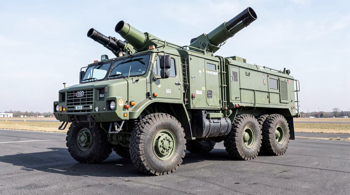
Modern rural fire departments have also adopted UTV platforms, such as the Can-Am Defender 6x6, to combat wildfires in remote terrain 16. These vehicles are frequently outfitted with specialized fire skids like the Defender XD or Minuteman XD, which provide water capacities ranging from 150 to 325 gallons 13. These skid units incorporate high-pressure pumps like the Waterax Versax 6, which can deliver 105 GPM at 120 PSI, allowing a single operator to conduct prescribed burning or wildfire suppression in areas inaccessible to traditional fire apparatus 14.
Technical Comparison of Primary Surplus Chassis
The following table provides a technical comparison of diverse chassis and firefighting configurations often found in the ex-military or military-grade firefighting market. These metrics illustrate the variance in power and capacity across different operational classes.
| Vehicle Model | Drivetrain | Engine Power | Water Capacity | Specialized Feature |
|---|---|---|---|---|
| Oshkosh P-15 8x8 | 8x8 | 1,000 HP (Twin V8) | 6,000 Gallons | Dual Pump System 3 |
| Mercedes Actros 1848 | 4x4 | 476 HP | 2,500L (FLF 24/25) | Telligent Semi-Auto 5 |
| Oshkosh MB-5 | 4x4 | 273 HP | Varies | Pump-and-Roll 6 |
| IVECO 6x6 Tanker | 6x6 | 470 HP | 11,000L | Cursor 13 Engine 8 |
| Land Rover IIB | 4x4 | ~90 HP (Petrol) | Varies | Forward Control 2 |
| Isuzu 700P 4T | 4x2 | 190 HP | 2,000L | Euro VI Emission 15 |
Integration into Civilian and Volunteer Fire Districts
Rural and volunteer fire departments frequently utilize ex-military assets to overcome geographic and budgetary obstacles. The durability of chassis like the HEMTT 6x6 or the Oshkosh P-19 makes them ideal for rough terrain where standard municipal equipment might fail 27. Furthermore, these departments can acquire high-capacity tankers, such as the IVECO 260-32 refueler, and convert them for water hauling in areas without hydrants 11. These ex-military trucks often come with pre-installed power take-off (PTO) systems, which are essential for driving high-volume water pumps 11.
Beyond traditional firefighting, decommissioned military trucks are repurposed for a wide array of support roles. Heavy equipment transporters like the Oshkosh M1070 HET, originally designed to move tanks and armored vehicles, can be used for logistical support in disaster zones 19. Specialized variants also include moving cook support vehicles, such as those built on the Sinotruk Sitrak 6x4 chassis, which can provide hot meals and water for up to 150 personnel during extended emergency deployments 25. This versatility makes ex-military inventory a critical resource for disaster management and specialized hazard response teams.
Market Risks, Regulatory Compliance, and Restoration Hurdles
Operating ex-military fire trucks in a civilian capacity involves significant regulatory and maintenance considerations. To be utilized in official firefighting operations, these vehicles often require modifications to meet National Fire Protection Association (NFPA) standards 27. This may involve upgrading lighting, seating, and safety systems that were not required for military use. Additionally, legacy vehicles like the Land Rover IIB may suffer from specific mechanical failures, such as bulkhead corrosion or pump priming issues, especially if they have been stored outdoors for extended periods 2.
Maintenance of specialized military drivetrains can also present a challenge due to the rarity of specific components. While many units use standard engines from manufacturers like Caterpillar or Detroit Diesel, specialized 8x8 drivetrains and custom bodywork by manufacturers such as HCB Angus or Ziegler require expert knowledge 2 5. Furthermore, the scale of these vehicles creates logistical friction. The Oshkosh P-15, for instance, has a width of 10 feet, which exceeds standard road width regulations in many jurisdictions, requiring special permits for transport 3. Prospective buyers must account for these ongoing operational costs and the reality of sourcing parts for platforms that may have been out of production for decades.
Sources
- Ex Army UK
- Defender Landrover
- Machines In Action
- Autoline (Steyr)
- Autoline (Mercedes)
- Wikipedia (Oshkosh MB-5)
- Fire Rescue Truck (CSCTRUCK)
- Fire Rescue Truck (IVECO)
- Fire Rescue Truck (MAN)
- Fire Rescue Truck (Mercedes)
- Autoline (IVECO Fuel)
- Military Trader
- Minute Manufacturing (Defender)
- Minute Manufacturing (Minuteman)
- Fire Rescue Truck (Isuzu 700P)
- UTV Guide
- Isuzu Vehicles (Water Tower)
- Cimc Firetruck (Sinotruk Howo)
- In The Lab (Oshkosh M1070)
- Autoline (Isuzu Pickup)
- Cimc Firetruck (Mercedes Actros 8x4)
- Autoline (Steyr 1291)
- The Autopian
- KYMA
- Cimc Firetruck (Sinotruk Sitrak)
- LinkedIn (Matthew Spencer)
- General Research Data (LLM summary)
Authored by MyTrendSpot team