Ex-Military All-Terrain Vehicles: A Technical Analysis of Market Dynamics and Engineering Specifications
The global market for ex-military all-terrain vehicles and tactical platforms has experienced significant expansion as defense modernization initiatives release surplus equipment into civilian and industrial sectors. The valuation of the global all-terrain vehicle market for defense was recorded at approximately $3.2 billion in 2025 1. This sector is projected to reach a valuation of $5.1 billion by 2034, representing a compound annual growth rate of 5.8 percent during the forecast period 1. North America currently maintains a dominant position in this market, accounting for approximately 38.2 percent of the total revenue share as geopolitical tensions and fleet upgrades drive the replacement of legacy hardware 2.
Global Market Distribution and Platform Segmentation
Within the defense all-terrain vehicle sector, utility models represent the largest segment, holding approximately 42.5 percent of the market share 2. These vehicles are primarily utilized for military logistics, reconnaissance, and border patrol operations. The broader tactical vehicle market, which includes heavier wheeled and tracked systems, reached an estimated value of $8.7 billion in 2025 and is expected to expand to $13.2 billion by the year 2034 3. This growth is attributed to the integration of autonomous technology and the ongoing modernization of military fleets in both developed and emerging economies.
Operational demand for high-mobility platforms has led to a diverse range of configurations, with wheeled vehicles holding a majority share of 58.3 percent 3. Procurement patterns indicate that defense forces are increasingly prioritizing modular designs that can be adapted for humanitarian aid program support, road construction, and mining operations following their service life 4. As reserve stocks are reduced due to governmental cutbacks, these vehicles enter the secondary market through specialized dealer networks and governmental disposal agencies.
Technical Specifications of Light and Medium Tactical Platforms
One of the most prominent platforms in the current surplus environment is the Oshkosh M-ATV, a mine-resistant ambush-protected vehicle designed to replace the M1114 HMMWV (Humvee) while providing improved mobility in complex terrains 5. The M-ATV features a 7.2-liter Caterpillar C7 inline-six engine producing 370 horsepower and 925 lb-ft of torque 5. Its curb weight is approximately 27,500 pounds, and it utilizes a TAK-4 independent suspension system to navigate off-road environments at speeds up to 65 miles per hour 5. Detailed specifications for primary tactical platforms are organized in the table below:
| Platform Model | Engine Type | Transmission | Curb Weight |
|---|---|---|---|
| Oshkosh M-ATV | 7.2L Caterpillar C7 | Allison 3500SP 6-Speed | 27,500 lbs 5 |
| International MXT-MV | International VT 365 | Allison 2500 SP | Variable 6 |
| GM Defense ISV-U | 2.8L Duramax Diesel | 6-Speed Automatic | Ultra-Light 7 |
| Mahindra Thar Roxx ATV | 2.2L Diesel | 6-Speed Automatic | Modified SUV 8 |
The International MXT-MV, or Military Extreme Truck, serves as an infantry mobility vehicle produced by Navistar Defense 6. Designed for transportability via Lockheed C-130 Hercules aircraft, it utilizes an Allison 2500 SP transmission and features an operational range of approximately 400 miles 6. Meanwhile, the GM Defense Infantry Squad Vehicle-Utility (ISV-U) is built on the Chevrolet Colorado ZR2 midsize truck platform, utilizing Multimatic Dynamic Suspension Spool Valve dampers for high-speed off-road performance 7.
Regional Developments and Indigenous Mobility Solutions
In South Asia, defense contractors are developing localized tactical mobility solutions to reduce reliance on imported platforms. The Mahindra Thar Roxx-based ATV is a purpose-built platform for security forces, featuring 4x4 hardware, a reinforced roll cage, and a 2.2-liter diesel engine delivering 172 horsepower and 400 Nm of torque 8. The vehicle includes structural modifications such as stripped-back body panels to improve approach and departure angles, along with a 360-degree turret mount for mission-specific equipment 9. This initiative reflects a broader trend toward indigenous manufacturing, as seen with the A-THON ASHVA series, which is designed specifically for military operations in the Himalayas and other extreme terrains 10.
Technological advancements also extend to unmanned systems like the UNEX Unmanned Ground Vehicle (UGV), a multi-role amphibious platform 11. This system supports logistics, demining, and casualty evacuation missions with a maximum payload capacity of 1,700 kilograms and a dry weight of 2,200 kilograms 11. The UNEX platform is engineered for environments ranging from -20 degrees Celsius to +40 degrees Celsius and features battery autonomy for up to six hours of operation 11. These developments represent the next generation of all-terrain defense technology, moving toward semi-autonomous navigation and resilient communication systems.
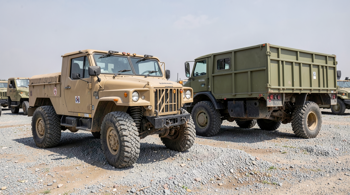
Expeditionary Conversions and Heavy Utility Assets
Ex-military vehicles are frequently utilized as foundations for overland expedition trucks due to their heavy-duty construction and proven mechanical reliability 12. The Stewart and Stevenson M1078 Light Medium Tactical Vehicle (LMTV) and the M939 series 5-ton truck are popular choices for these conversions because of their modular chassis and high load-carrying capacity 13. In Europe, the Mercedes-Benz Unimog U5000 is often repurposed for adventure tours, featuring portal axles, an 8-speed transmission, and wading ability facilitated by raised air intakes 14. These vehicles provide a torsion-free subframe articulation that is essential for maintaining stability across uneven landscapes 12.
Surplus equipment also includes specialized maritime and logistics assets. The Air Portable Ferry Bridge (APFB) workboat sections, released from reserve stocks, are powered by Schottel waterjets and Deutz air-cooled diesel engines 15. These pontoons were originally designed for rapid deployment military bridge systems and demonstrate the extreme build quality inherent in defense-grade machinery 15. Additionally, legacy platforms like the Land Rover 90 continue to be sought after for their mechanical simplicity and eligibility for tax and MOT exemptions in certain jurisdictions such as the United Kingdom 16.
Operational Limitations and Maintenance Requirements
Despite their high capability, ex-military all-terrain vehicles present specific operational challenges for civilian owners. Many decommissioned units, such as the AM General M35A3, have limited top speeds and require specialized maintenance due to their unique engineering 17. These trucks are often significantly taller and wider than conventional vehicles, which may restrict access to standard infrastructure 17. Furthermore, these platforms frequently utilize 24-volt electrical systems, necessitating conversion kits or specialized chargers for standard 12-volt civilian accessories 13.
Supply chains for specialized components like heavy-duty all-terrain tires remain critical for the continued operation of these fleets. Tires such as the Michelin XZL 11.00R20 and the 395/85R20 are essential for maintaining traction in mud, snow, and sand 18. These radial tires are designed with steel belts and elastic protector plies to ensure casing integrity in off-road conditions 19. Owners often rely on authentic military surplus stock that has been professionally inspected to maintain the performance standards required for heavy utility or industrial rigs 18.
Regulatory Compliance and Export Frameworks
The acquisition and movement of ex-military vehicles are governed by strict regulatory frameworks. In the United Kingdom, any vehicle or component part considered to be specially designed for military use requires an export license if it is to be taken out of the country for any reason 4. This includes platforms released due to fleet upgrades or reserve stock reductions. Domestically, these vehicles must comply with appropriate registration, licensing, and insurance requirements to be legally operated on public roads 4.
In the United States, many surplus tactical vehicles are sold with an off-road use only designation because they lack federal safety features such as airbags and modern lighting required for standard street registration 13. Buyers must navigate state-specific Department of Motor Vehicles regulations, which vary significantly regarding the titling and registration of former military equipment 13. These administrative barriers, combined with high fuel consumption and the complexity of field maintenance, represent the primary friction points for the civilian adoption of surplus all-terrain defense technology 12.
Sources
- MarketIntelo - All Terrain Vehicle for Defense Market Research Report 2034
- MarketIntelo - All-Terrain Tactical Vehicle Market Research Report 2034
- MarketIntelo - Global Tactical Vehicle Market Outlook 2025-2034
- ExArmyUK - Export Licensing and Vehicle Information
- Wikipedia - Oshkosh M-ATV Technical Specifications
- Wikipedia - International MXT-MV Platform Details
- Congressional Medal of Honor Society - GM Defense ISV-U Auction Release
- Autocar India - Mahindra Thar Roxx-based ATV for Indian Army
- Times Now - Mahindra Thar Roxx Military Vehicle Structural Changes
- Raksha Anirveda - India’s Tactical Mobility Independence: The A-THON Story
- ABRIS-DG - UNEX Unmanned Ground Vehicle Specifications
- Motorcraft Adventure Developments - Ex-Military Camper Builds in Overland
- General Research Data - Surplus Vehicle Commonality and 24V Systems
- Unicat Expedition Vehicles - Unimog U5000 Technical Specifications
- Witham Specialist Vehicles - APFB Pontoon and Workboat Specifications
- John Brown 4x4 - Land Rover 90 Ex-Military Technical Data
- The Fast Lane Truck - M35A3 Decommissioned Military Truck Review
- Uncle Wiener - 11.00R20 Michelin XZL Military Surplus Tire Data
- Uncle Wiener - 395/85R20 Michelin XZL Heavy-Duty Tire Specifications
Authored by MyTrendSpot team