Ex-Military Searchlights: A Detailed Analysis of Historical Hardware and Contemporary Repurposing
Ex-military searchlights are surplus lighting equipment derived from decommissioned military installations and maritime vessels, typically utilizing carbon arc or xenon lamp technology from the Cold War era 25. These devices, which once served critical roles in anti-aircraft defense and perimeter security, are now categorized as niche assets for historical preservation, cinema production, and bespoke interior design 1.
Historical Context and Strategic Defense Utility
The strategic deployment of searchlights dates back to major global conflicts, where they functioned as the primary means of nighttime aerial target detection. During the late 19th century, the British military established electric light positions along the Victoria Lines in Malta to illuminate land approaches and harbor entrances 11. These installations were distinct from the anti-aircraft units that would emerge during World War II, such as the 70th (Sussex) Searchlight Regiment, which was equipped with 90 cm projectors featuring automatic carbon feed lamps 12.
In maritime and aerial warfare, searchlights like the Leigh Light were integrated into Vickers Wellington aircraft to counter the threat of diesel submarines surfacing at night to recharge batteries 10. The ability to suddenly illuminate the ocean surface allowed Coastal Command pilots to detect and engage targets that were otherwise invisible in the darkness. On land, the General Electric 60-inch searchlight became a standard U.S. Army mobile unit, utilizing a 60-inch rhodium-plated reflector to project a beam capable of being seen for many miles 25.
Technical Specifications and Beam Intensity Metrics
The performance of ex-military searchlights is measured by peak beam candlepower and effective range. Traditional carbon arc models are noted for producing between 800,000 and 2.5 billion candlepower depending on the configuration and power input 25. Modern handheld equivalents, such as the Maxa Beam MBS-410, utilize 85-watt xenon short arc lamps to achieve 12 million peak beam candlepower, enabling target identification at distances exceeding 3,500 meters 8. The divergence of these beams is often as narrow as 1.5 to 2 degrees, ensuring high penetration through atmospheric clutter 14.
Standard industrial and naval signaling projectors often operate on 230V systems, with wattage variants ranging from 250W to 1000W 14. A 1000W xenon arc model can generate a lux value of 40 million at one meter, whereas specialized marine searchlights like the Boyuan Navy Search Gen II offer a beam range of up to 6 kilometers for commercial workboats and coastal security 15. These metrics reflect the extreme engineering required to sustain high-intensity light output over extended operational durations.
Comparative Lighting Technology Table
| Model Type | Light Source | Peak Intensity / Lumens | Maximum Range |
|---|---|---|---|
| GE 60-inch Projector | Carbon Arc | 800 Million Candlepower | Over 10 Kilometers 25 |
| Maxa Beam MBS-410 | Xenon Short Arc | 12 Million Candlepower | 3,500 Meters 8 |
| Samalite SL2000Li | LED Technology | 4,600 Lumens | 1,300 Meters 16 |
| HawkStar X | LED Technology | 4,200 Lumens | 600 Meters 20 |
Modern Military and Tactical Drone Detection
In contemporary defense environments, searchlights have seen a resurgence in utility for counter-drone operations. Manufacturers like SpaceRay produce mobile anti-aircraft searchlights specifically designed for mobile air defense units to detect strike drones such as the Shahed 4. These units typically feature IP65 water and dust protection, ranges up to 5 kilometers, and integrated beam adjustment to track rapid aerial threats in urban or field environments 4.
Advanced tactical lighting systems also include remote-controlled motorized platforms that allow for 360-degree horizontal rotation and wide tilt ranges from +60 to -35 degrees 5. Models such as the Betalight 420160 are designed for armored vehicles and comply with military standards like MIL-STD-810F for environmental resistance and MIL-STD-461E for electromagnetic compatibility 5. These systems often provide dual-mode operation, switching between visible white light and infrared output for use with night vision equipment 6.
Restoration Trends and Industrial Repurposing
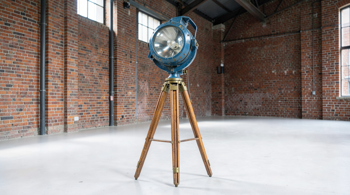
The secondary market for ex-military searchlights has expanded into the realm of high-end vintage restoration. Units manufactured in 1950s Hungary by EKA (Elektromos Készülékek és Anyagok Gyára) were originally intended for field operations but are now sought after as architectural floor lamps 1. These searchlights, characterized by heavy-gauge steel enclosures and original stenciled markings, are often mounted on authentic World War II-era wooden tripods, resulting in sculptural pieces that stand over two meters tall 1.
Restoration involves sensitive cleaning of the blue enamelled steel or aluminum patina and the replacement of internal carbon-arc mechanisms with modern E26 or E27 lamp holders 3. Fully restored 1950s Hungarian units are valued at approximately $4,137 or 3,000 GBP, reflecting the labor-intensive nature of electrical conversion and heritage preservation 1, 2. These repurposed assets are frequently utilized in large entrance halls, bars, and film studios to provide industrial character 3.
Portable Professional Lighting Solutions
For search and rescue, police, and industrial maintenance, portable ex-military grade searchlights provide reliable illumination without the infrastructure requirements of larger trailer-mounted units. The NightSearcher HawkStar series, for example, offers 2500 to 4200 lumens with runtimes reaching up to 9.5 hours 18, 20. These rechargeable units are IP65 or IP67 rated, ensuring they remain functional in extreme weather conditions, including frost and high heat 16.
Higher intensity portable units, such as the ProStar 2-in-1, combine a 10,000-lumen searchlight with a floodlight function, specifically engineered for scene-of-crime investigations and search operations 21. Weight is a critical factor in these designs; while historical units were cumbersome, modern lithium-ion technology allows a 4600-lumen searchlight like the Samalite SL2000Li to weigh only 1.6kg while maintaining a 1300-meter beam 16. These tools are standard issue for railways, emergency services, and mountain rescue teams 16.
Operational Risks and Maintenance Realities
Operating vintage ex-military searchlights involves significant technical friction. Original carbon arc projectors require substantial electrical infrastructure, often necessitating 3-phase power and 200 to 400 amp service for larger 60-inch models 25. Furthermore, the carbon rods consumed during operation are increasingly scarce, making the transition to xenon or LED sources a practical necessity for most collectors and commercial operators 25.
Regulatory compliance also presents challenges, as many high-powered beams can interfere with aviation safety if not properly permitted. The restoration of a vintage unit can range in cost from $2,000 to over $10,000, depending on the integrity of the rhodium-plated mirrors and the condition of the motorized components 25. For modern units, maintaining IP ratings (such as IPX7 for immersion) requires regular seal inspections and adherence to MIL-STD testing protocols to ensure longevity in maritime or desert environments 6.
Sources
- Loomlight Design - Hungarian Military Searchlight Floor Lamp Details
- Loomlight Design - US Pricing and Inventory Data
- Loomlight Design - Vintage Searchlight Tripod Restoration Info
- SpaceRay - Anti-aircraft Searchlights for Air Defense
- Betalight Tactical - Model 420160 Remote Controlled Searchlight
- Betalight Tactical - 420175 LED Military Searchlight Standards
- Loomlight Design - 1950s Hungarian Searchlight Specifications
- Good Firearms - Maxa Beam MBS-410 Technical Data
- Carlisle and Finch - 15-Inch LED Searchlight Performance
- Key Aero - Vickers Wellington Searchlight History
- Times of Malta - Victoria Lines Defence Electric Lights
- Wikipedia - 70th (Sussex) Searchlight Regiment RA History
- HandWiki - Engineering and Military Use of Searchlights
- Rayen Enterprises - Signalling Projector Xenon Arc Specs
- Boyuan Lighting - Navy Search Gen II Marine Specifications
- Samalite - SL2000Li Rechargeable LED Searchlight Specs
- RiggingUK - NightSearcher SL1600 Product Data
- RS Online - Nightsearcher HawkStar LED Searchlight Details
- RiggingUK - HawkStar 2500 Lumens IP65 Data
- Cabledrumjacks - HawkStar X 4200 Lumens Performance
- RiggingUK - ProStar 10,000 Lumens Searchlight Specs
- DP Light - DP-7342 Laser LED Searchlight Features
- MarketPressRelease - Sigma Search Lights Industrial Solutions
- U.S. Army Center of Military History - General Historical Records
- Vintage Military Lights - General Searchlight Technology and Restoration Records
Authored by MyTrendSpot team