Ex-Military Fuel Tankers: A Comprehensive Industry and Market Analysis
Ex-military fuel tankers attract sustained interest from industries ranging from emergency response to agricultural fuel distribution. These vehicles were engineered to operate under extreme conditions, and their technical specifications often exceed what is available in equivalent civilian-built equipment. Understanding the market landscape, dominant vehicle platforms, and compliance requirements is essential before engaging with this category of surplus equipment.
Dominant Vehicle Platforms and Technical Specifications
The most widely documented ex-military fuel tanker platform in U.S. inventory is the M978 HEMTT, a Heavy Expanded Mobility Tactical Truck variant carrying a 2,500-gallon fuel tank. 1 The vehicle runs on an 8x8 drivetrain, which gives it exceptional off-road mobility, allowing tankers to reach forward positions that standard wheeled fuel trucks cannot access. 1 The M978 can carry JP-8 jet fuel, diesel, or MOGAS gasoline in segregated compartments, and a trained crew can empty the full 2,500-gallon tank in under 20 minutes during fast-moving operations. 1
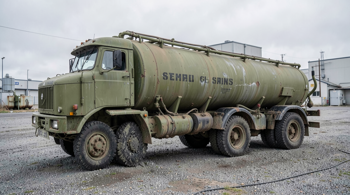
British and European military disposals feature a different but equally varied lineup. Documented surplus examples include the MAN 8x8 fuel and water tanker, the MAN 4x4 7,500-litre bunded fuel tanker, a Leyland DAF 4x4 5,000-litre tanker refueller, and an Ex-Royal Navy DAF 50/160 4x2 9,000-litre AVGAS aviation fuel delivery bowser. 2 The Mercedes Axor 8x6 and MAN 25.322 represent additional tanker platforms that have entered the surplus market following military decommissioning. 2 Capacities across this category range from approximately 5,000 litres for smaller 4x4 tactical refuellers up to 30,000 litres for heavier multi-axle platforms such as the Steyr Oil Tanker 30000L, a three-axle unit originating from Chinese military inventory. 3
Primary Disposal and Acquisition Channels
In the United States, decommissioned military fuel tankers enter the civilian market primarily through Defense Logistics Agency (DLA) Disposition Services, which manages Department of Defense surplus property for recycling, reuse, or transfer. 4 GovPlanet, a major government surplus auction platform, regularly lists ex-military equipment including fuel tankers and tank trailers from authorized government sources. 5 Ritchie Bros. Auctioneers and its associated platform IronPlanet conduct regular heavy equipment auctions that include former military tankers and specialized fuel transport vehicles. 6 Purple Wave also auctions used equipment in the tank trailer and tanker categories, which can include ex-military units sold into civilian markets. 7
Outside the United States, government surplus disposal organizations and specialist dealers manage the process. UK-based platforms cataloguing MoD and NATO disposals list tanker trucks across multiple drive configurations and capacity classes. 2 The HMK Bilcon TC 12D tank container represents a newer generation of tactical fuel solution designed to integrate transport, storage, and dispensing of diesel and jet fuel into a single unit, enabling standardisation across the entire logistics supply chain and facilitating dispersed deployment from fourth to first echelon. 8 Market pricing observed across international auction data historically ranges from approximately $8,000 to $25,000 for smaller and mid-capacity units, depending on model age, condition, and maintenance records. 9
Common Civilian Repurposing Applications
Once decommissioned and cleared through appropriate channels, ex-military fuel tankers serve a range of civilian industries. The robust construction and high-capacity tanks make them practical for construction site fuel supply, agricultural operations requiring bulk diesel delivery, and small-scale fuel distribution businesses serving remote areas. 9 Emergency response organisations value the off-road capability of platforms like the M978 HEMTT, which can access terrain inaccessible to standard commercial tanker trucks. 1
Specialist tank container designs such as the TC 12D can additionally function as standalone pump stations, reducing the need for separate pump units in connection with container or bladder-based fuel storage facilities. When deployed in camp or garrison-style civilian environments, the unit can be equipped with a 400V electric drive system kit. 8 Veterans with military fuel-handling backgrounds frequently transition into civilian fuel logistics roles, with experience operating platforms such as MAN military trucks in unit support tanker driver roles and working alongside civilian fuel companies through structured military attachments. 10
Regulatory Compliance and Conversion Requirements
Acquiring an ex-military fuel tanker for civilian commercial use involves a significant compliance burden that prospective operators must not underestimate. In the United States, vehicles intended for hazardous materials transport require DOT certification and must meet inspection standards governing hazmat transport and storage. 11 Commercial truck conversion specialists provide modification and certification services to bring ex-military tankers into legal compliance with civilian fuel distribution regulations. 12 Tank construction materials, pressure equipment standards, and valve configurations may all require updating before a vehicle can be legally operated.
In the United Kingdom, personnel transitioning from military fuel roles such as Royal Logistic Corps bulk fuel operations or UK Ministry of Defence petroleum specialist positions bring ADR (Agreement concerning the International Carriage of Dangerous Goods by Road) qualifications and dangerous goods handling knowledge directly applicable to civilian compliance requirements. 10 This crossover of regulatory knowledge is particularly relevant given that military vehicles are not automatically certified for civilian dangerous goods transport and require documented compliance inspections regardless of their prior service record.
Condition Assessment and Known Risk Factors
Ex-military fuel tankers present specific inspection risks that differ from standard commercial vehicle acquisitions. A documented case involving a Stewart and Stevenson M1079 military truck acquired for $13,000 illustrates common findings: despite recording only 553.7 miles on the odometer, the vehicle had sat idle for 13 years, resulting in severely rotted fuel lines, seized hydraulics, and dry-rotted seals throughout. 13 The 553-mile Cat 3116 engine was described as essentially brand new, yet extended storage had caused diesel to weep freely from dry-rotted fuel lines despite the pristine engine block condition. 13
Aluminum tank construction, common in many ex-military tanker models, offers corrosion resistance but demands careful inspection for structural integrity and degraded seal conditions before any fuel-handling use. 9 Vehicles stored for extended periods in outdoor conditions will typically present compromised rubber components, degraded hydraulic fluid, and potentially contaminated internal tank surfaces. International surplus market advisories consistently recommend comparing multiple sale offers to identify anomalous pricing, which can indicate hidden mechanical defects or structural issues not disclosed in basic listings. 3
Market Geography and Export Considerations
The ex-military fuel tanker market operates globally. UK surplus vehicles are documented as being prepared for export to international buyers, with logistics and shipping services forming part of the disposal ecosystem. Buyers outside the country of origin must account for export licensing requirements, which vary depending on the vehicle type, its last-known military classification, and the destination country. 2 Left-hand versus right-hand drive configuration is a practical consideration affecting deployability in specific markets, as military vehicles from UK and Australian inventories are predominantly right-hand drive while continental European and US assets are typically left-hand drive.
The Steyr Oil Tanker 30000L, listed at approximately USD 18,500 on multiple international auction platforms, represents a mid-market benchmark for large-capacity three-axle ex-military fuel trucks entering the global secondary market from Asian military inventories. 3 Copart operates as a leading used vehicle and equipment auction site that includes military surplus tankers and related equipment accessible to international buyers, further expanding the geographic reach of this secondary market. 14
Sources
- Military Vehicles Vault - militaryvehiclesvault.com
- Ex Army UK (GovSales) - exarmyuk.com
- Autoline International (Steyr Military Retired Fuel Truck listing) - autoline.nl
- Defense Logistics Agency Disposition Services - dla.mil
- GovPlanet - govplanet.com
- Ritchie Bros. Auctioneers - rbauction.com
- Purple Wave - purplewave.com
- HMK Bilcon TC 12D Tank Container - hmkbilcon.com
- Defense Logistics Agency / General Military Surplus Market Data - dla.mil
- LinkedIn Professional Profiles - Military Fuel Logistics Veterans - linkedin.com
- U.S. Department of Transportation - dot.gov
- American Truck Equipment Association - atea.org
- Yahoo Autos / BradenBuildz M1079 Military Truck Revival - autos.yahoo.com
- Copart - copart.com
Authored by MyTrendSpot team