Ex-Military Radio Sets: A Technical Analysis of Historical Tactical Communication Systems
Surplus tactical hardware enthusiasts frequently study ex-military radio sets to understand the evolution of field communications and the engineering required for combat durability. These devices, ranging from early vacuum tube units used in the 1940s to the solid-state encrypted systems of the late Cold War, represent a significant era in electronics development where reliability in extreme environments was the primary design objective. The historical lifecycle of these sets often begins in active service, followed by periods of storage and eventual disposal through government surplus cycles, where they are acquired by researchers and historical preservationists who value their ruggedized, waterproof construction and adherence to strict military specifications 31.
The Transition from Vacuum Tubes to Solid-State Engineering
The technological shift in tactical communications is perhaps best exemplified by the move from vacuum tube technology to solid-state components during the mid-20th century. Early manpack systems like the AN/PRC-10, which entered service in 1951, utilized a 16-tube FM receiver and transmitter architecture to serve as a squad-level radio 3. These units were part of a broader family that included the PRC-8 and PRC-9, differing primarily in their frequency of operation and the specific components used to determine those frequencies 31. While effective for their time, the fragile nature of vacuum tubes and the high power requirements of these sets created logistical challenges for infantry units operating in remote areas.
By the late 1960s, the introduction of the AN/PRC-77 marked a significant upgrade in military radio design by replacing the vacuum-tube-based final power amplifier stage with solid-state components 1. This advancement not only increased the reliability of the device but also allowed for the integration of voice encryption hardware, such as the TSEC/KY-38 NESTOR and the later KY-57 VINSON family 1. Unlike its predecessor, the PRC-25, the PRC-77 could support secure voice transmissions, though it remained incompatible with the more modern SINCGARS frequency-hopping modes that would follow in the 1980s 1.
Vietnam Era Manpack Transceivers and Operational Impact
During the Vietnam War, tactical radio systems became indispensable for ground operations, leading to high praise from military leadership. In 1967, General Creighton Abrams described the AN/PRC-25 as the most important tactical item in the conflict at that time 2. This set, commonly referred to by its nickname in the field, was typically carried on a substantial backpack harness to facilitate mobility 2. However, the weight and ergonomics of the unit often made it difficult to stabilize during static use, leading many operators to remove the radio from its pack harness for better placement in fixed positions 2.
The technical specifications of these Vietnam-era sets provided coverage across the VHF spectrum, typically ranging from 30.00 to 75.95 MHz across two distinct bands 2. Operators utilized a variety of antennas based on the mission profile, including three-foot flexible battle whips for patrols and ten-foot rigid antennas for maximum range 1. The logistical footprint for these radios included a Complete Equipment Schedule (CES) featuring handsets, harnesses, antenna bases (known as goosenecks), and specialized battery cases, though many surviving units found in research collections today often lack their original power sources 1.
British Tactical Networks and the Clansman Family
The British military implemented its own standardized communication network known as Clansman, which served from 1976 until approximately 2010 12. Developed by the Signals Research and Development Establishment (SRDE), the Clansman system replaced the older Larkspur radio architecture and introduced significant advances such as Single SideBand (SSB) operation and NarrowBand Frequency Modulation (NBFM) to forward combat areas 12. The family consisted of nine main units, designated as either UK/PRC (Portable) or UK/VRC (Vehicle), and saw extensive use in operations ranging from the Falklands War to the Gulf War 12.
Key British Radio Models
- PRC-320 (RT-320): A high-frequency (HF) transceiver designed by Plessey, capable of wide-range contacts and often modified by modern users for amateur bands 11.
- Wireless Set No. 19: A 1940s-era two-band transceiver used in armored fighting vehicles, featuring a crew intercom system and multiple operating modes like CW and AM voice 4, 14.
- Wireless Set C13: A post-war HF workhorse introduced in the late 1940s for command posts and armored units, providing long-range voice and Morse code capabilities 10.
Specialized Intelligence and Naval Hardware
Beyond standard infantry sets, several ex-military radio sets were designed for highly specialized missions, including espionage and clandestine operations. The GRC-109, often called the Jeep of the radio world, was a ruggedized spy set used extensively by the CIA and Special Forces from the 1950s through the 1970s 16. It was noted for its extreme durability and versatile power options, making it a primary tool for stay-behind units and detachment camps in forward areas 16. In the 1980s, NATO developed the FS-5000 system, code-named HARPOON, which allowed for digitally encrypted messages to be sent over distances of 6,000 kilometers in less than one second, though it faced significant security challenges from rival intelligence services 22.
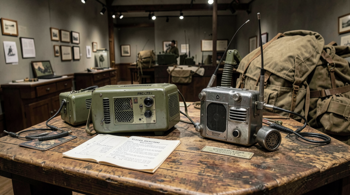
Maritime operations also required unique solutions, such as the TBY-6 radio used by the U.S. Navy and USMC, famously associated with the Navajo Code Talkers during World War II 9. These sets were often carried in canvas bags and used on PT boats as backup units 9. Because these radios lacked Moisture Fungus Proofing (MFP), their operational life in humid environments like the South Pacific was often short, making surviving, well-preserved examples exceptionally rare today 9.
Axis Power Field Radio Engineering in World War II
The German military also developed specialized portable radios, such as the Feldfunksprecher f, which was designed for Panzergrenadiere to maintain direct communication with the tanks they supported 5. Introduced relatively late in the war, this set operated in the 28 to 33 MHz range to ensure compatibility with tank-mounted FU5 sets 5. To accommodate the 10-meter wavelength, the system utilized a 1.20-meter strip antenna with a lengthening coil to optimize signal transmission 5.
Another late-war development was the Kleinfunksprecher d, also known as the Dorette, which began production in October 1944 6. This highly compact transceiver was designed for short-range infantry communication and consisted of a small apparatus case worn on the shoulder and a battery box worn on the belt 6. These units are of interest to technical historians because they represent the final stage of German tactical radio design during the Third Reich, emphasizing miniaturization and interoperability with existing backpack transceivers 6.
Maintenance Realities and Historical Preservation Safety
Restoring and maintaining ex-military radio sets involves significant technical and safety considerations. Many vintage units from the mid-20th century utilized radium paint on the front panels to allow the lettering and dials to glow in the dark 15. This paint is radioactive and must be handled with care to avoid contamination, especially as it ages and becomes brittle 15. Furthermore, modern researchers must contend with the lack of original battery types, often requiring the construction of custom power supplies or adapters to achieve the high voltages required by older vacuum tube circuits 3.
| Technical Concern | Operational Reality |
|---|---|
| Radium Paint | Found on sets like the AN/GRC-9; requires specialized handling due to radioactivity 15. |
| Battery Absence | Original dry cells are generally dead or missing; requires modern power adapters 1. |
| Component Aging | Capacitors and oscillators often require replacement before the first power-up to prevent circuit damage 31. |
| Encryption Hardware | Historical sets with COMSEC features often require specialized knowledge for repair and testing 25. |
Technical documentation is vital for any preservation effort. Professional repairers in military settings often maintained a bench stock of replacement parts and utilized troubleshooting procedures documented in technical manuals to keep a wide variety of systems operational 25, 27. For those interested in historical communications, the research process involves not only the physical restoration of the chassis but also the study of the waveforms and frequencies used during the equipment's original service life 30.
Sources
- Backcountry Hunt Shop: Original U.S. Vietnam War AN/PRC-77 Radio ManPack Set
- Colt & Winchester Firearms: Original Vietnam War U.S.M.C. Radio Set RT-505B / PRC-25
- WW2 Originals: Original U.S. Korean War Vietnam War AN/PRC-10 Backpack Radio
- Aero Vintage Limited: No.19 Mk III British military vehicle radio in transit case
- GunToyNet: Original German WWII Portable Field Radio Feldfunksprecher f
- RangeProGear: Original German WWII Kleinfunksprecher d - Dorette
- Army Group 1944 Militaria: Vintage Tommy Gunn Radio Communications Pack
- Radio Workshop: G4NSJ – The WS 19 Set
- PrecisionGunPro: Original U.S. WWII Navy USMC Navajo Code Talker TBY-6 Radio
- PA2JF.nl: The Wireless Set C13 Transceiver: A British Workhorse
- Radio Workshop: G4NSJ – Clansman military radio equipment
- Wikipedia: Clansman (military radio)
- Vault Militaria: Original WW2 British Army Wireless Set No.19 & No.22 Spare Valve Case
- Go2Share: Wireless Set No. 19 Overview and Historical Context
- Ham Radio - QRP: AN/GRC-9 aka Angry Nine
- SV7APQ Ahillefs: GRC-109
- Tony Allen EI4DIB: PRC-351/2 VHF Military Manpack Transceiver
- N4WIS: Radio Restoration
- Backcountry Hunt Shop: SB-22A/PT Field Communications Set Transit Chest
- Backcountry Hunt Shop: SB-22A/PT Field Telephone manual switchboard
- Chennai HAM/VHF Enthusiasts Forum: AN/PRC-148 Multiband Radio
- Military Analysis: FS-5000
- Armada International: Sprucing up Norwegian Army Comms
- Avalon ARC: The 31 Set
- LinkedIn: Jose Vargas - Radio and COMSEC Repairer
- Deep3DSea: Er 315 Military Radio Game Ready Model
- LinkedIn: Michael Jones - Information Systems Technician
- LinkedIn: Gerard Gray - Chief Radio Electronics Technician
- LinkedIn: Schaffner Lyles - Chief Radio Electronics Technician
- LinkedIn: Nathan Bradley - Senior Test Analyst
- General Research Data Payload: Technical specifications and general historical context for surplus radio sets
Authored by MyTrendSpot team