Prostate Cancer: Understanding Risk Factors and Treatment Plans
How Common Is Prostate Cancer and Who Does It Affect
Prostate cancer ranks as the most commonly diagnosed non-cutaneous cancer in men and the second leading cause of cancer-related death in men after lung cancer. 1 The American Cancer Society estimates approximately 333,830 new cases in the United States for 2026. 2 Roughly 1 in 8 men will receive a prostate cancer diagnosis during their lifetime, and the disease accounts for nearly 30% of all new cancer cases in men each year in the United States. 3
The median age at diagnosis is 66 years, and incidence rises sharply after age 50. 4 Approximately 80 to 85 percent of all prostate cancers are detected in the local or regional stages, which correspond to stages I, II, and III, when treatment options carry the strongest outcomes. 5 The 10-year survival rate across all combined stages is reported at 98%, reflecting improvements in screening sensitivity and treatment precision over recent decades. 6
Primary Risk Factors: Age, Race, and Family History
Age is consistently identified as the single strongest non-modifiable risk factor for prostate cancer, with incidence rising exponentially after age 50 and the disease remaining rare before age 40. 4 Racial and ethnic background constitutes a separate, significant variable. African American men have materially higher incidence rates and an earlier age of onset compared to Caucasian men, and are more than twice as likely to die from prostate cancer than men of other races. 7 They are also more likely to present with advanced disease at the time of initial diagnosis.
Family history amplifies individual risk substantially. If a father or brother has been diagnosed with prostate cancer, an individual's personal risk doubles. 8 Approximately 10 to 15 percent of all prostate cancers are considered familial in origin. 4 A family history of breast cancer, ovarian cancer, pancreatic cancer, or colon cancer has also been associated with elevated prostate cancer risk due to shared hereditary pathways.
Genetic Mutations and Inherited Susceptibility
Inherited germline mutations represent a clinically important subset of prostate cancer risk. Mutations in BRCA1 and BRCA2 genes, along with mismatch repair genes associated with Lynch syndrome, are recognized as hereditary factors that increase the likelihood of developing aggressive prostate cancer. 9 BRCA2 mutations in particular are linked to earlier onset and more aggressive disease phenotypes. Genetic testing using blood, saliva, or tumor tissue can identify these germline mutations, enabling more personalized surveillance strategies.
A second category of genetic analysis examines somatic mutations, meaning changes found only within cancer cells rather than inherited through the germline. 10 These tumor-level profiles help clinicians assess whether certain targeted therapies may be appropriate. The 2026 AUA/ASTRO Guideline Amendment incorporated updated guidance on imaging and shared decision-making for localized prostate cancer, reflecting the growing role of molecular profiling in treatment planning. 11
Lifestyle and Environmental Considerations
While age, race, and genetics are non-modifiable, researchers continue to study the influence of modifiable factors on prostate cancer risk and progression. Obesity and a diet high in red or processed meats have been associated with increased risk of more aggressive forms of the disease. 12 Conversely, regular physical activity and diets that emphasize plant-based foods are studied for potential protective associations, though the European Association of Urology notes that no conclusive data currently support specific preventive dietary measures as a definitive risk-reduction strategy. 13
It is important for readers to understand that no lifestyle intervention eliminates prostate cancer risk entirely, and that the absence of known modifiable risk factors does not preclude diagnosis. The interaction between dietary patterns, metabolic health, and genetic predisposition remains an active research area, and clinicians generally recommend individualized risk discussions rather than population-wide prescriptive guidance.
Screening, Staging, and Diagnosis
The prostate-specific antigen (PSA) blood test is the primary screening instrument used to detect early signs of prostate cancer. Elevated PSA levels may indicate cancer, though other conditions such as benign prostatic hyperplasia can also raise PSA values. 14 Medical organizations including the AUA, USPSTF, and NCCN offer varying recommendations on when to initiate screening and how frequently to test, generally advising individualized decisions based on age and personal risk profile. Multiparametric MRI and MRI-targeted fusion biopsy have emerged as important diagnostic tools that improve detection accuracy, particularly for clinically significant disease.
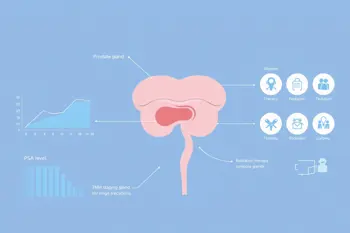
Staging uses the TNM system, which assesses tumor extent (T1 through T4), regional lymph node involvement (N), and distant metastasis (M), combined with PSA level and Gleason score or Grade Group to assign an overall stage from I to IV. 15 Stage IV prostate cancer, also called metastatic disease, carries a five-year survival rate averaging 28%, substantially lower than local or regional stage cancers. 5 Prostate cancer most commonly metastasizes to the bones, particularly the hips, pelvis, and spine, and can cause significant pain and fractures when it does.
Treatment Plans Across Disease Stages
For localized prostate cancer confined to the prostate gland, the two primary curative-intent options are radical prostatectomy (surgical removal) and radiation therapy. Clinical data show that ten-year survival exceeds 99% for lower-risk disease treated with either modality, and approximately 96% for higher-risk localized disease treated with either surgery or radiation. 16 The choice between these approaches typically involves consideration of individual health status, patient preferences, and the side-effect profiles of each treatment rather than any demonstrated survival advantage of one over the other.
Active surveillance, involving regular PSA monitoring and digital rectal examination, is a widely accepted management strategy for slow-growing, low-risk localized disease, allowing many patients to defer intervention without compromising outcomes. 17 For locally advanced disease (stages T3-T4), the established standard of care is external beam radiation therapy combined with androgen deprivation therapy (ADT), with abiraterone now recommended in selected high-risk cases. 18 Systemic therapies for metastatic disease include hormone therapy, chemotherapy, PARP inhibitors for patients with HRR mutations such as BRCA1/2, and the radiopharmaceutical Lutetium-177 PSMA-617, which received FDA approval and extends overall survival in PSMA-positive metastatic castration-resistant prostate cancer following prior ARPI and docetaxel treatment. 19 Androgen receptor pathway inhibitors including enzalutamide, apalutamide, and darolutamide combined with ADT have demonstrated a 30 to 40 percent reduction in death risk for metastatic hormone-sensitive disease across major clinical trials including ARCHES, TITAN, and ENZAMET. 20
Prognosis, Recurrence, and Emerging Directions
The overall prognosis for prostate cancer is among the most favorable of all cancers, largely because the majority of cases are caught through screening at an early, treatable stage. Five-year relative survival approaches 100% for local and regional stage disease, and the long-term outlook continues to improve as precision medicine integrates comprehensive genomic profiling with biomarker-driven patient stratification. 21 PSA doubling time under 10 months is recognized as a signal of aggressive biochemical recurrence and may warrant earlier intervention. 20
Emerging research directions include epigenetic regulators, immune-modulating agents, metabolic pathway inhibitors, and cell-surface protein targets, all explored within the context of molecular profiling to address tumor heterogeneity and treatment-resistant disease phenotypes. 22 Precision medicine frameworks now allow clinicians to identify which patients carry DNA damage repair alterations, enabling the rational selection of PARP inhibitors and other targeted agents, while AI-assisted tools are being incorporated into disease management review processes as outlined in the 2026 AUA Guideline Amendment. 11 Patients navigating treatment decisions benefit from multidisciplinary team involvement, which typically includes urologists, radiation oncologists, medical oncologists, and specialist nurses at defined points throughout the care pathway.
Sources
- MedMind AI - Prostate Cancer: Epidemiology, Diagnosis, and Evidence-Based Treatment (medmind.pro)
- American Cancer Society - Key Statistics for Prostate Cancer (cancer.org)
- npj Precision Oncology - Genomic Landscape and Precision Therapy in Prostate Cancer (nature.com)
- MedMind AI - Prostate Cancer: Epidemiology, Diagnosis, and Evidence-Based Treatment (medmind.pro)
- Johns Hopkins Medicine - Prostate Cancer Prognosis (hopkinsmedicine.org)
- Memorial Sloan Kettering Cancer Center - New Prostate Cancer Treatments Aim to Reduce Deaths and Avoid Side Effects (mskcc.org)
- Mayo Clinic / Medical Xpress - Prostate Cancer Explained: From Antigen Tests to Treatment Options (medicalxpress.com)
- eCancerMedicalScience - Understanding Prostate Cancer: What You Need to Know (ecancermedicalscience.com)
- Acibadem International - Prostate Cancer Causes and Risk Factors (acibademinternational.com)
- PROCURE - Genetic Testing and Precision Medicine (procure.ca)
- Journal of Urology - Clinically Localized Prostate Cancer: AUA/ASTRO Guideline Amendment 2026 (doi.org)
- Dr. Shrey Jain Urology - Prostate Cancer Risk Factors, Symptoms, and Screening (dr-shreyjain.com)
- Medscape / EAU 2025 Guideline Summary - Prostate Cancer Epidemiology and Aetiology (reference.medscape.com)
- Medical Xpress - Prostate Cancer Explained: From Antigen Tests to Treatment Options (medicalxpress.com)
- 247 Healthcare Blog - Prostate Cancer Staging TNM (247healthcare.blog)
- Mayo Clinic - Prostate Cancer Treatment: Surgery vs. Radiation (mayoclinic.org)
- Memorial Sloan Kettering Cancer Center - Prostate Cancer Overview (mskcc.org)
- World Journal of Urology - Contemporary Management of Locally Advanced Prostate Cancer (link.springer.com)
- ClearCancer Circle - Prostate Cancer Treatment in 2026: From Early Disease to mCRPC (ccc.lighthope.ai)
- ClearCancer Circle - Prostate Cancer Treatment in 2026: From Early Disease to mCRPC (ccc.lighthope.ai)
- MDPI Biomedicines - Precision Medicine in Prostate Cancer with a Focus on Emerging Therapeutic Strategies (mdpi.com)
- EMBO Molecular Medicine - New Frontiers in Prostate Cancer Treatment from Systemic Therapy to Targeted Therapy (link.springer.com)
Authored by MyTrendSpot team