Varicose Veins: Causes, Symptoms, and Effective Treatment Methods
Understanding the Anatomy: What Varicose Veins Actually Are
Varicose veins are abnormally enlarged, dilated, and tortuous superficial veins most commonly developing in the lower extremities. 1 The condition develops when the small one-way valves inside leg veins, responsible for pushing blood upward toward the heart against gravity, weaken or fail entirely. 2 When these valve flaps separate, blood flows backward under gravitational pull, rapidly filling the vessel and causing the thin-walled vein to enlarge even further, producing the characteristic rope-like bulge visible beneath the skin. 3
It is clinically important to distinguish varicose veins from spider veins. Spider veins are smaller, web-like clusters of capillaries closer to the skin surface that typically do not cause physical discomfort, whereas varicose veins are larger, deeper, and capable of generating pain, swelling, and, in advanced cases, serious circulatory complications. 4 The condition is classified within the broader category of chronic venous disease and is staged using the CEAP classification system, ranging from C2 (visible varicosities) through C6 (active venous ulcers). 5
Primary Causes and the Valve Failure Mechanism
The precise underlying cause of varicose veins is not fully established, but the primary mechanism involves either primary venous valvular insufficiency with reflux or primary dilation of the vein wall due to structural weakness. 6 As vein walls lose elasticity over time, the vessels stretch and elongate, forcing the elongated vein to become convoluted within the same spatial constraints it previously occupied. Once the valve flaps separate, blood that would normally be directed toward the heart instead pools in the superficial venous network, a process that progressively worsens with continued standing or activity. 3
Genetics represent the single most significant identifiable cause. Research indicates that if both parents carry varicose veins, the lifetime risk for offspring reaches approximately 89%, dropping to 47% when only one parent is affected, and remaining at roughly 20% when neither parent is affected. 7 A 2018 study published in Circulation by Fukaya et al. confirmed both clinical and genetic determinants of varicose vein development, reinforcing the role of inherited collagen-elastin fiber composition in early valve failure. 6 In rare cases, varicose veins are associated with Klippel-Trenaunay-Weber syndrome, which includes congenital arteriovenous fistulas. 6
Risk Factors: Who Is Most Susceptible
Varicose veins affect approximately 30% of the general population at some point during their lives and are two to three times more common in women than in men. 8 Estrogen is understood to influence venous wall structure directly, while pregnancy amplifies risk through increased blood volume, elevated pelvic venous pressure, and hormonal relaxation of vein walls. Research notes that pregnancy-related varicose veins affect roughly 40% of pregnant women, and while many improve after delivery, a significant proportion persist and may require clinical assessment. 9
The following table summarizes the principal evidence-backed risk factors as reported across major clinical sources:
| Risk Factor | Mechanism |
|---|---|
| Family history / Genetics | Inherited vein wall and valve structural weakness |
| Female sex and hormonal changes | Estrogen affects venous structure; menstruation, pregnancy, and menopause elevate risk |
| Pregnancy | Increased blood volume and uterine pressure on pelvic veins |
| Advancing age | Progressive loss of vein wall elasticity and valve function |
| Obesity | Excess body weight increases venous pressure in lower extremities |
| Prolonged standing or sitting | Occupational exposure over 4 hours per day doubles risk |
| Prior deep vein thrombosis | Damage to deep venous valves elevates superficial venous pressure |
Symptoms: From Early Warning Signs to Severe Complications
Visible, blue or purple twisted veins are typically the first observable indicator, but many patients experience significant symptomatic burden before veins become externally prominent. 5 Common early and intermediate symptoms documented across clinical literature include aching, heaviness, throbbing, burning, and cramping sensations in the legs, all of which characteristically worsen after prolonged standing or during warm weather and improve with leg elevation and rest. 10 Swelling of the feet and ankles, dry and itchy skin over the affected vein, and nighttime muscle cramps are also widely reported. 10
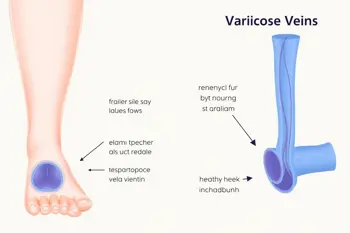
When varicose veins are left unaddressed, the condition can progress to more serious manifestations. Skin changes including hyperpigmentation, thickening, and a condition called lipodermatosclerosis can develop around the ankle region. 5 In advanced cases, venous ulcers that resist healing for more than two weeks may form. A critical complication is deep vein thrombosis (DVT), which occurs when blood clots form in the deeper leg vessels and can dislodge, potentially causing a pulmonary embolism. 11 Any sudden onset of a hot, red, and painful area along a varicose vein warrants prompt medical evaluation.
Conservative and Lifestyle-Based Management
The majority of varicose vein cases do not immediately require procedural intervention. Conservative management focuses on reducing venous hypertension through modifiable behavioral and mechanical strategies. 12 Compression stockings are universally recognized as the first-line non-invasive approach; these graduated compression garments apply calibrated external pressure to the leg, improving the efficiency with which the calf muscle pump returns blood toward the heart, reducing swelling and discomfort. 13
Beyond compression therapy, evidence-based lifestyle measures include regular aerobic exercise, particularly walking, which activates the calf-muscle venous pump; weight reduction to decrease baseline venous pressure; periodic elevation of the legs above heart level; and avoidance of prolonged static standing or seated postures. 14 For workers in high-risk occupations such as nursing, teaching, or retail, clinical guidance recommends brief walking breaks of approximately five minutes every hour combined with graduated compression stockings during working hours. 7 These conservative measures manage symptoms effectively in many individuals but do not eliminate existing venous reflux or structurally damaged valves.
Minimally Invasive and Surgical Treatment Options
For cases where conservative management fails to adequately control symptoms, or where complications such as skin changes or ulceration are present, a range of procedural interventions is available. Endovenous ablation, including both radiofrequency ablation and endovenous laser treatment, has largely replaced traditional surgical vein stripping over the past two decades. 15 These techniques use thermal energy delivered via a thin catheter inserted into the affected vein to seal the vessel from the inside, causing blood to reroute through functional adjacent veins. Patients typically resume normal activities rapidly, and general anesthesia is not required. 15
Sclerotherapy involves the direct injection of a chemical sclerosant solution into the target vein, which causes controlled inflammation, fibrosis, and eventual collapse of the vessel. 16 It is particularly effective for smaller branch varicosities and spider veins. Ambulatory phlebectomy, also called microphlebectomy, removes superficial veins through a series of very small skin punctures under local anesthesia and is reserved for larger surface varicosities that are not suitable for ablation alone. 17 It is clinically important to note that while modern treatments are highly effective, recurrence of varicose veins following any intervention remains a documented possibility, as the underlying genetic predisposition to venous wall weakness is not eliminated by treating existing diseased veins. 3 Accurate pre-procedural mapping using venous duplex ultrasound to identify the specific source of reflux is widely considered essential for achieving durable long-term outcomes. 18
Sources
- Cleveland Clinic - Varicose Veins: Symptoms, Causes and Treatment (my.clevelandclinic.org)
- UC Davis Health - Treating Varicose Veins: What You Need to Know (health.ucdavis.edu)
- Merck Manual Consumer Version - Varicose Veins, reviewed by James D. Douketis, MD, McMaster University, Jan 2026 (merckmanuals.com)
- Penn Medicine - Varicose Veins: Symptoms and Causes (pennmedicine.org)
- Citi Vascular Centre - Varicose Veins Causes and Symptoms: CEAP Classification (citivascularcentre.com)
- MSD Manual Professional Edition - Varicose Veins, reviewed by James D. Douketis, MD, and Jonathan G. Howlett, MD, Jan-May 2026 (msdmanuals.com)
- Dr. Raja Veins Clinic - What Causes Varicose Veins: 9 Real Causes and Risk Factors Explained, 2026 (drrajaveinsclinic.com)
- Wikipedia - Varicose Veins: Epidemiology and Overview (en.wikipedia.org)
- Advanced Heart and Vascular Institute - How Are Varicose Veins Treated Today, Jan 2026 (advancedhvi.com)
- NHS Inform - Varicose Veins: Symptoms and Treatment (nhsinform.scot)
- Penn Medicine - Varicose Veins: Deep Vein Thrombosis and Complications (pennmedicine.org)
- Ontario Vascular - Causes of Varicose Veins and Prevention Tips (ontariovascular.com)
- Cleveland Clinic - Compression Stockings and Conservative Treatment (my.clevelandclinic.org)
- National Heart, Lung, and Blood Institute - Lifestyle Modifications for Varicose Veins (nhlbi.nih.gov)
- Acibadem International - Varicose Veins Treatment Options, Risks, and Recovery Time, Jul 2026 (acibademinternational.com)
- American Academy of Dermatology - Sclerotherapy for Varicose and Spider Veins (aad.org)
- St. Vincent's Medical Center - 5 Treatments for Varicose Veins, Aug 2025 (stvincents.org)
- The Whiteley Clinic - Varicose Veins: Understanding Causes and Treatment (thewhiteleyclinic.co.uk)
Authored by MyTrendSpot team