Top 10 Cataract Surgery Clinics in the United States
How Top Cataract Surgery Clinics Are Evaluated in the U.S.
The United States performs more cataract surgeries than almost any other country, with roughly 3.7 million procedures completed annually. 1 With such volume, distinguishing genuinely elite clinics from average-performing facilities requires structured, multi-factor analysis. U.S. News & World Report evaluates more than 4,500 hospitals across 15 specialties, and only 13% achieve a Best Hospitals designation in any category. 2 For ophthalmology specifically, the methodology relies heavily on expert opinion surveys, with unaffiliated physician nominations weighted more heavily than affiliated endorsements to reduce bias.
Separately, U.S. News published its 2026 Best Ambulatory Surgery Centers list, evaluating more than 4,400 ASCs using three years of Medicare data. 3 Facilities were scored on how successfully they avoided complications, emergency room visits, and unplanned hospitalizations. Nearly 300 ASCs earned top-rated status in ophthalmology nationally, with California, Florida, and Texas each contributing more than 20 facilities to that list. These two ranking systems together form a comprehensive picture of institutional excellence in cataract care.
Top 10 Cataract Surgery Clinics: National Rankings Overview
The following institutions represent the most consistently recognized cataract surgery destinations in the country, drawing primarily from U.S. News & World Report's 2025-26 Best Hospitals for Ophthalmology rankings, which were released on July 29, 2025. 2 Ophthalmology specialists nationwide were surveyed to identify the top institutions, making the list a direct reflection of peer consensus within the field.
| Rank | Institution | Location |
|---|---|---|
| 1 | Bascom Palmer Eye Institute, University of Miami Hospital | Miami, FL |
| 2 | Wills Eye Hospital, Thomas Jefferson University Hospitals | Philadelphia, PA |
| 3 | Wilmer Eye Institute, Johns Hopkins Hospital | Baltimore, MD |
| 4 | Mass Eye and Ear, Massachusetts General Hospital | Boston, MA |
| 5 | Stein and Doheny Eye Institute, UCLA Medical Center | Los Angeles, CA |
| 6 | University of Iowa Health Care Medical Center | Iowa City, IA |
| 7 | Duke University Hospital Eye Center | Durham, NC |
| 8 | University of Michigan Health Kellogg Eye Center | Ann Arbor, MI |
| 9 | John A. Moran Eye Center, University of Utah Health | Salt Lake City, UT |
| 10 | Cole Eye Institute, Cleveland Clinic | Cleveland, OH |
Clinic Profiles: Institutions Ranked 1 Through 4
Bascom Palmer Eye Institute has held the number one position in U.S. News ophthalmology rankings for 22 consecutive years as of 2025, a record unmatched by any other eye institution in the country. 2 Located in Miami, it is affiliated with the University of Miami and is recognized for groundbreaking research alongside exceptional patient outcomes in cataract removal, retinal treatment, glaucoma care, and corneal transplantation. Wills Eye Hospital in Philadelphia, founded in 1832, is one of the oldest dedicated eye care centers in America and draws patients from around the world for procedures including cataract removal, pediatric ophthalmology, and ocular oncology. 4
The Wilmer Eye Institute at Johns Hopkins Hospital in Baltimore is globally recognized for innovation in IOL technology and complex surgical case management. 5 Dr. Nakul Shekhawat, an Assistant Professor of Ophthalmology at Wilmer and the 2023 Stephen F. Raab and Mariellen Brickley-Raab Rising Professor, specializes in complex cataract and anterior segment surgery and received the Claes Dohlman Award from Harvard Medical School for outstanding cornea fellowship performance. 6 Mass Eye and Ear in Boston, ranked fourth nationally, is a primary teaching hospital for Harvard Medical School and maintains fellowship-trained surgeons such as Dr. Zhonghui K. Luo, who focuses on complex and premium cataract surgeries and holds board certification from the American Board of Ophthalmology. 7
Clinic Profiles: Institutions Ranked 5 Through 10
The Stein and Doheny Eye Institute at UCLA Medical Center in Los Angeles offers specialized cataract care for patients with pre-existing conditions that complicate standard surgical approaches, including advanced anterior segment disease. 8 Duke University Hospital Eye Center in Durham, North Carolina, provides access to clinical trials for emerging lens technologies and performs femtosecond laser-assisted cataract surgery as a standard offering for eligible patients. 9 The University of Iowa Health Care Medical Center, ranked sixth nationally, serves as a major Midwest referral center with particular strength in corneal and comprehensive anterior segment procedures.
The University of Michigan Health Kellogg Eye Center in Ann Arbor ranks eighth and is recognized as a prestigious residency training site; Dr. Shekhawat of Johns Hopkins completed his ophthalmology residency there and received the Resident Excellence Award from the American Society of Cataract and Refractive Surgery. 6 The John A. Moran Eye Center at the University of Utah is globally recognized for its surgical training programs and international outreach in cataract care. 8 The Cole Eye Institute at Cleveland Clinic, ranked tenth, performs thousands of cataract surgeries annually using advanced IOL platforms and consistently appears on U.S. News specialty rankings. 10
Technology Standards at Leading Cataract Clinics
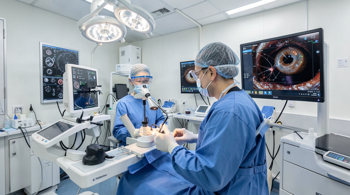
Top-ranked cataract surgery clinics in the United States have adopted laser-assisted cataract surgery (LACS) using femtosecond laser platforms as a standard option for increased incision precision and capsulotomy accuracy. Traditional phacoemulsification remains highly effective and is performed in approximately 10 to 15 minutes per eye at modern outpatient facilities, with an overall success rate for visual improvement exceeding 98%. 1 The shift toward premium intraocular lenses has added a significant layer of complexity to surgical planning, with options including monofocal, toric, multifocal, trifocal, and extended depth-of-focus designs that aim to reduce post-operative spectacle dependence.
One notable technology advancement is the Light Adjustable Lens (LAL) by RxSight, which is the only FDA-approved IOL that can be reshaped after implantation using ultraviolet light treatments. Clinical data indicate that 79% of LAL patients achieved 20/20 vision without glasses, compared to 33% with a standard monofocal lens. 11 Surgical volume also correlates directly with outcome quality; registry data from Sweden show that posterior-capsule rupture rates declined from approximately 2.8% in 2002 to 0.5% in 2024 as procedural volumes and techniques matured. 12
Cost, Insurance, and Eligibility Considerations
The average cataract surgery cost with insurance coverage is approximately $1,653 per eye based on aggregated platform data, though this figure reflects standard procedures only. 13 Medicare and most major insurance plans cover standard cataract surgery with a basic intraocular lens when the procedure is deemed medically necessary. However, elective upgrades including premium multifocal lenses, toric lenses for astigmatism correction, and laser-assisted surgical techniques are generally excluded from coverage and require out-of-pocket expenditure. Geographic location, facility type, surgeon reputation, and the complexity of any concurrent ocular conditions all influence final costs.
Patient eligibility for advanced lens options is determined through comprehensive pre-operative evaluation, including advanced biometry and high-resolution ocular imaging. More than 25 million Americans are currently affected by cataracts, and that figure is projected to exceed 50 million by 2050 as the population ages. 13 Patients with pre-existing conditions such as macular degeneration, severe corneal disease, or prior refractive surgery may face limitations on premium IOL candidacy, making subspecialty-trained surgeons at academic centers particularly important for complex cases.
Risks, Recovery, and What Patients Should Know Before Choosing a Clinic
Cataract surgery carries a strong safety profile when performed at accredited facilities by experienced surgeons, but it is not without risk. Known complications include posterior capsule rupture, infection (endophthalmitis), cystoid macular edema, and refractive surprises where the implanted lens does not achieve the intended visual target. Complication rates are significantly lower at high-volume centers; industry benchmarks suggest that posterior capsule rupture rates below 1.0% require surgeons performing at least 400 cataract cases per year. 12 Patients evaluating clinics should ask about a surgeon's individual annual case volume, complication disclosure policies, and whether the facility holds AAAHC or JCAHO accreditation.
Recovery from standard cataract surgery is typically rapid, with most patients discharged the same day, though visual stabilization with premium lenses may take several weeks as the eye adapts. 1 Newsweek, in partnership with Statista, identifies America's leading cataract surgeons annually through peer recommendations, surgical outcome analysis, technology adoption, and patient satisfaction ratings. The 2025 list recognized physicians across multiple states, including Dr. David F. Chang in Mountain View, California, and Dr. Nicole R. Fram at Good Samaritan Hospital in Los Angeles, among others, reflecting that clinical excellence is distributed across a range of institutional and private practice settings. 14
Sources
- Miami Eye Institute – Advanced Cataract Surgery Overview: miamieyesurgeon.com
- Ophthalmology Times – Bascom Palmer Eye Institute Ranked Top Ophthalmology Hospital for 22nd Consecutive Year: ophthalmologytimes.com
- Becker's ASC – The Best Ophthalmology ASCs: U.S. News 2026 Rankings: beckersasc.com
- Sarkari Result – Top 10 Best Eye Surgery Hospitals in the USA: sarkarinresult.com
- Johns Hopkins Medicine – Wilmer Eye Institute Cataract Surgery Services: hopkinsmedicine.org
- Johns Hopkins Medicine Provider Profile – Dr. Nakul Shekhawat, MD, MPH: profiles.hopkinsmedicine.org
- Mass General Brigham Provider Profile – Dr. Zhonghui K. Luo, MD, PhD: doctors.massgeneralbrigham.org
- Mayo Clinic – Cataract Surgery Care Overview: mayoclinic.org
- Duke Health – Cataract Surgery at Duke Eye Center: dukehealth.org
- Cleveland Clinic – Cole Eye Institute Overview: my.clevelandclinic.org
- DiseaseFix – Choosing the Best Light Adjustable Lens Cataract Surgeons in Bonita Springs: diseasefix.com
- Plastic Surgery Key – Best Board Certified Eye Surgeons Naples FL: Surgical Volume and Cataract Outcomes: plasticsurgerykey.com
- AllClinics – How Much Does Cataract Surgery Cost in the U.S.: allclinics.io
- Newsweek Rankings – America's Leading Doctors 2025: Cataract Surgery: rankings.newsweek.com
Authored by MyTrendSpot team