Varicose Veins Symptoms and Treatments: Clinical Analysis and Contemporary Management
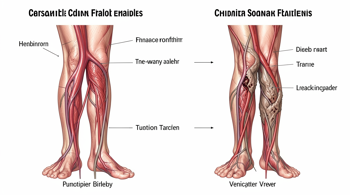
Varicose veins symptoms and treatments represent a significant area of vascular medicine, as these swollen, twisted, and bulging blood vessels affect millions of adults globally. Often presenting as blue or purple bulges just under the skin of the legs, feet, or ankles, they develop when venous walls weaken and internal one-way valves fail 1. When these tiny valves are damaged, they cannot keep blood moving toward the heart, causing blood to back up and pool within the superficial vessels 1. While many individuals initially view these twisted veins as a minor cosmetic concern, they can signal underlying vascular inefficiencies and lead to progressive discomfort or serious clinical complications 1, 7.
The Physiological Mechanisms of Venous Insufficiency
To understand the development of varicose veins, it is necessary to examine the mechanics of the circulatory system. Veins serve as the channels returning blood to the heart, working against gravity in the lower extremities 3. This return flow relies on the contraction of calf muscles, which acts as a pump, and tiny one-way valve flaps that close to prevent backward flow 11, 16. When these venous walls lose their elasticity or the valves weaken, the valve leaflets separate 2. When an individual stands, gravity pulls blood backward through these separated flaps, a phenomenon known as venous reflux 2, 17.
This backflow causes blood to pool in the superficial veins, which are located just beneath the skin 2. The resulting venous hypertension forces the thin-walled vessels to stretch, elongate, and widen 2, 11. To fit within their original anatomical space, the stretched veins become convoluted, appearing as rope-like or snakelike bulges beneath the skin 2. This progressive dilation can eventually spread to the connecting veins that link the superficial system to the deep venous system, further exacerbating venous reflux and pressure throughout the lower extremities 2.
Recognizing Key Symptoms and Clinical Signs
While some individuals with varicose veins experience no pain, many present with physical symptoms that can impact daily quality of life 8. The most common indicators of symptomatic vein disease include a persistent aching, throbbing, or a distinct feeling of heaviness and fatigue in the legs 4, 8. Patients also frequently report localized itching over the affected veins, burning sensations, and muscle cramps in the calves or thighs, which often intensify at night 4, 5. These symptoms are typically exacerbated by warm weather or after standing or sitting for uninterrupted periods, and they often improve when the legs are elevated 5, 8.
It is clinically useful to distinguish varicose veins from other venous presentations. The following table contrasts the three primary types of superficial venous anomalies based on clinical characteristics 1, 7, 8:
| Vein Type | Typical Size and Depth | Visual Appearance | Associated Physical Symptoms |
|---|---|---|---|
| Trunk Varicose Veins | Large, deep superficial branches | Thick, bulging, twisted blue or purple ropes | Aching, heaviness, swelling, cramping, and skin changes |
| Reticular Veins | Medium-sized, intermediate depth | Flat, blue, green, or purple networks | Mild localized discomfort or itching |
| Spider Veins | Small, capillary-level superficial vessels | Fine, web-like red or purple lines | Generally asymptomatic; primary cosmetic concern |
Associated Risks and Potential Complications
Leaving progressive varicose veins untreated can lead to advanced stages of chronic venous insufficiency (CVI) 11, 24. Over time, high venous pressure causes fluid to leak into surrounding tissues, resulting in persistent swelling or edema in the lower legs and ankles 5, 11. Chronic congestion alters skin integrity, leading to dry, scaly, and itchy skin that is highly susceptible to cracking 4. In advanced cases, the skin near the ankles can harden, thicken, or change color, turning a dark, leathery brown 4, 12. These skin changes can progress to painful, slow-healing sores known as venous stasis ulcers, which typically form just above the ankle and carry a high risk of infection 4, 12.
Beyond localized tissue damage, varicose veins are associated with deeper circulatory complications. Patients with varicose veins have an elevated risk of developing superficial thrombophlebitis, which is an inflammatory blood clot in a vein close to the skin surface 16. More critically, there is a documented link between varicose veins and deep vein thrombosis (DVT), where blood clots form in the deep leg muscles 4, 12. If these deep clots break loose, they can travel to the lungs and cause a life-threatening pulmonary embolism 4. Urgent medical evaluation is required if a patient experiences sudden leg swelling, severe calf pain, local heat, redness, or chest pain 4, 23.
Epidemiology, Genetics, and Lifestyle Risk Factors
Varicose veins are highly prevalent, affecting approximately 20% to 25% of all adults in the United States, with some estimates indicating that up to 30% of the global population will experience the condition 16, 25. Epidemic and clinical data reveal that women are twice as likely as men to develop varicose veins, primarily due to hormonal influences 16. Estrogen and progesterone can relax vein walls, making the valves more prone to leaking 6. This hormonal influence is particularly evident during pregnancy, when blood volume increases to support the fetus, placing added pressure on the pelvic and leg veins 3, 19.
Genetic predisposition is another primary risk factor, with approximately 50% of varicose vein cases running in families, suggesting an inherited weakness in the vein walls or valve structures 3. Additional risk factors include advanced age, which brings natural wear on valve leaflets, and obesity, which increases intra-abdominal pressure 3, 19. Occupations that require prolonged, uninterrupted standing or sitting, such as nursing, teaching, or office work, significantly increase venous pressure because the calf muscles remain inactive and cannot pump blood upward 3, 15. Lack of regular physical exercise and smoking also impair overall circulatory health, compounding the risk 25.
First-Line Conservative Treatments and Self-Care
The initial management of varicose veins typically focuses on non-surgical, conservative measures to improve circulation and relieve symptoms 9. The most widely recommended first-line treatment is compression therapy 9, 13. Graduated compression stockings apply steady pressure to the lower legs, with the tightest compression at the ankle, gradually loosening as the stocking goes up 13. This pressure prevents the superficial veins from dilating, which helps the internal valves close properly, reduces blood pooling, and alleviates leg aching, throbbing, and swelling 13. These garments are available in various styles, including knee-high, thigh-high, and full leggings, depending on the anatomical extent of the affected veins 13.
In addition to compression therapy, patients can implement several lifestyle modifications to manage symptoms and prevent progression 16:
- Leg Elevation: Elevating the legs above the level of the heart for 15 to 20 minutes several times a day uses gravity to facilitate venous drainage 9, 23.
- Physical Activity: Engaging in regular, low-impact exercise like walking or swimming contracts the calf muscles, actively pumping blood back to the heart 16, 25.
- Weight Management: Maintaining a healthy weight reduces the overall hydrostatic pressure exerted on the lower extremity venous system 16, 23.
- Postural Changes: Avoiding long periods of continuous sitting or standing by taking regular breaks to walk, and avoiding tight clothing that restricts blood flow 3, 23.
Modern Minimally Invasive and Surgical Interventions
When conservative measures are insufficient to manage symptoms, or if a patient experiences advanced complications, a vascular specialist may recommend procedural intervention 4, 9. Modern vascular medicine has shifted away from traditional open surgeries, such as vein stripping, toward minimally invasive, outpatient techniques 19. These advanced treatments close or remove the faulty veins under local anesthesia, redirecting blood flow to healthier deeper veins and allowing patients to return to normal activities quickly 19.
Common procedural options include endovenous thermal ablation, which utilizes radiofrequency energy or laser heat delivered via a thin catheter to seal the damaged vein from the inside 9, 21. Another widely utilized treatment is sclerotherapy, during which a chemical solution or foam is injected directly into the vein, causing the vessel walls to stick together, collapse, and eventually be absorbed by the body 2, 21. For highly twisted superficial veins close to the skin surface, a microphlebectomy may be performed, involving the removal of the veins through tiny skin punctures that require no stitches 19, 21. While these procedures are highly effective at eliminating existing varicose veins, they do not cure the underlying venous weakness, and new varicose veins may develop over time 2.
Sources
- Cleveland Clinic: https://my.clevelandclinic.org/health/diseases/4722-varicose-veins
- Merck Manual Consumer Version: https://www.merckmanuals.com/home/heart-and-blood-vessel-disorders/venous-disorders/varicose-veins
- Harvard Health Publishing: https://www.health.harvard.edu/heart-health/varicose-veins-a-to-z
- Penn Medicine: https://www.pennmedicine.org/conditions/varicose-veins
- NHS inform: https://www.nhsinform.scot/illnesses-and-conditions/a-to-z/varicose-veins/
- MSD Manual Professional Edition: https://www.msdmanuals.com/professional/cardiovascular-disorders/peripheral-venous-disorders/varicose-veins
- Tampa General Hospital: https://www.tgh.org/institutes-and-services/conditions/varicose-veins
- Womenshealth.gov: https://womenshealth.gov/a-z-topics/varicose-veins-and-spider-veins
- UC Davis Health: https://health.ucdavis.edu/musculoskeletal-health/news/headlines/treating-varicose-veins-what-you-need-to-know/2025/09
- Merck Manual Consumer Version: https://www.merckmanuals.com/en-ca/home/heart-and-blood-vessel-disorders/venous-disorders/varicose-veins
- StatPearls (NCBI): https://www.ncbi.nlm.nih.gov/books/NBK430975/
- Yale Medicine: https://www.yalemedicine.org/conditions/chronic-venous-insufficiency
- Cleveland Clinic Health Essentials: https://health.clevelandclinic.org/varicose-vein-remedies
- Acibadem Hospitals Group: https://acibademinternational.com/health-library/varicose-veins-treatment-options-risks-and-recovery-time/
- Essentia Health: https://www.essentiahealth.org/about/essentia-health-newsroom/general-surgery-varicose-vein-treatment-your-guide-to-relief
- Wikipedia: https://en.wikipedia.org/wiki/Varicose_veins
- Manipal Hospitals: https://www.manipalhospitals.com/oldairportroad/blog/varicose-veins-in-the-legs-early-signs-diagnosis-and-minimally-invasive-care/
- HVS Hospitals: https://www.hvshospitals.com/varicose-veins
- Advanced Heart & Vascular Institute: https://www.advancedhvi.com/2026/01/02/how-are-varicose-veins-treated-today/
- St. Joseph's Health: https://stjosephshealth.org/healthy-you/healthy-legs-happy-life-expert-advice-on-varicose-vein-treatment/
- Vein Treatment Clinic: https://www.veintreatmentclinic.com/conditions/varicose-veins
- Nuvance Health (Northwell Health): https://www.nuvancehealth.org/health-tips-and-news/7-symptoms-of-varicose-veins-you-shouldnt-ignore
- Artemis Hospital: https://www.artemishospitals.com/blog/varicose-veins-symptoms-causes-treatment
- Integrative Cardiology: https://integrativecardio.com/what-are-varicose-veins/
- Vein Specialists of the South: https://www.veinspecialists.com/condition/varicose-veins/
Authored by MyTrendSpot team