Atopic Dermatitis and Skin Eczema: Clinical Differences and Overlap
When managing chronic skin inflammation, the terminology used in clinical and everyday settings can frequently cause confusion. Many patients wonder if atopic dermatitis is the same as skin eczema, as these terms are regularly used interchangeably in patient literature and regional medical practices 2. While atopic dermatitis is indeed the most common form of eczema, eczema itself is an umbrella term representing at least seven distinct inflammatory skin conditions 4. Accurately identifying the exact subtype is essential because therapeutic selection, insurance categorization, and regulatory approvals for systemic treatments depend heavily on precise clinical criteria 4.
Understanding the Nomenclature: Eczema vs. Atopic Dermatitis
The term eczema serves as a broad classification for a family of inflammatory skin disorders characterized by dryness, redness, and intense itching 4. Within this category, atopic dermatitis stands out as a highly specific, chronic, and systemic condition 4. Originally coined in 1933 by Wise and Sulzberger, the term atopic dermatitis emphasizes the patient's underlying genetic predisposition to atopic conditions, which include allergic asthma, rhinoconjunctivitis, and food allergies 3 8. Conversely, other forms of eczema may arise entirely from external triggers or localized physiological changes without any systemic atopic link 2 10.
While clinicians in the United Kingdom and Europe frequently use the term atopic eczema, modern scientific literature exhibits a strong preference for atopic dermatitis 3. This disease affects approximately 15% to 20% of children and 1% to 10% of adults globally, representing more than 230 million individuals 10. Because of its prevalence, accounting for up to 80% of all eczema cases, atopic dermatitis has historically dominated public discussions of skin irritation 13. However, relying on this single label can obscure other diagnoses, leading to delayed or inappropriate treatment plans 12.
Key Clinical Differentiators and Prevalence Metrics
Distinguishing atopic dermatitis from other eczema subtypes requires an evaluation of the age of onset, specific physical presentation, and the anatomical distribution of the lesions. Atopic dermatitis typically presents as a relapsing-remitting disease with age-dependent clinical patterns, peaking in early childhood 6 9. In contrast, other forms of eczema, such as contact dermatitis or stasis dermatitis, develop due to direct exposure to external irritants or underlying circulatory dysfunction 7.
| Eczema Subtype | Primary Triggers | Characteristic Distribution | Age of Onset |
|---|---|---|---|
| Atopic Dermatitis | Genetic mutations (FLG), immune dysregulation, environmental allergens 9 10 | Flexural folds (elbows, behind knees), face and extensor surfaces in infants 3 9 | Typically infancy or early childhood (under age 5) 7 9 |
| Contact Dermatitis | Direct contact with irritants (soaps) or allergens (nickel, plant oils) 7 11 | Localized directly to the area of contact 7 | Any age, based on exposure patterns 11 |
| Dyshidrotic Eczema | Stress, moisture, metal exposure, seasonal changes 13 | Palms of the hands, sides of the fingers, soles of the feet 7 | Typically young adulthood |
| Nummular (Discoid) Eczema | Dry skin, minor skin injuries, cold climates 13 | Coin-shaped lesions on the lower legs, forearms, and torso 7 | Common in older adults |
Pathophysiology and the Role of Skin Barrier Defects
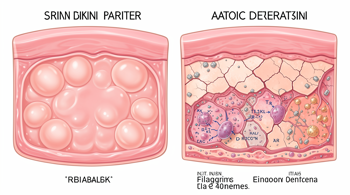
The underlying biological mechanisms of atopic dermatitis involve a complex interplay of epidermal barrier dysfunction, immune system dysregulation, and microbial imbalance 8 10. A central driver is a genetic mutation in the filaggrin (FLG) gene, which is present in 25% to 30% of European patients with atopic dermatitis 10. Filaggrin is a critical structural protein required for maintaining the integrity of the stratum corneum. A deficiency in filaggrin leads to a 3-fold to 5-fold increase in transepidermal water loss, drying the skin and allowing allergens and pathogens to penetrate easily 10.
This compromised barrier triggers an overactive immune response dominated by the type 2 helper T-cell (Th2) pathway 10 12. Elevated levels of cytokines, specifically interleukin-4 (IL-4) and interleukin-13 (IL-13), further suppress the production of filaggrin and loricrin, worsening the barrier defect 10. While non-atopic eczema variants may also display barrier vulnerability, they lack this highly specific systemic Th2 immune skewing and the corresponding elevation of serum immunoglobulin E (IgE) levels 1 10.
The Diagnostic Process and Clinical Mimics
Because there is no single definitive biomarker for atopic dermatitis, diagnosis remains entirely clinical 1. Dermatologists rely on established diagnostic frameworks, such as the Hanifin and Rajka criteria or the UK Working Party criteria, which require the presence of chronic pruritus alongside historical and physical findings 5 9. Accurate diagnosis is further complicated by numerous clinical mimics 1. Conditions such as seborrheic dermatitis, psoriasis, and scabies can present with overlapping symptoms of redness, scaling, and itching 1 9.
The distinction between atopic dermatitis and psoriasis is particularly critical. While both are chronic inflammatory skin diseases characterized by immune dysregulation, they involve entirely different pathways 12 14. Psoriasis is driven by the IL-23/Th17 pathway, resulting in thick, well-demarcated plaques with silvery scales that typically appear on outer joints like elbows and knees 12. Conversely, atopic dermatitis is driven by the Th2 pathway, presenting with ill-demarcated, highly pruritic, and lichenified lesions in the flexural folds 12 14.
Management Strategies and Overlapping Therapies
The therapeutic journey for managing any form of eczema begins with establishing a strong skin barrier 11. Consistent application of high-quality emollients is the absolute mainstay of basic therapy for all severities of skin inflammation 9 11. For active inflammatory flares, mild-to-moderate cases across all eczema subtypes are treated with topical anti-inflammatory agents, including topical corticosteroids and topical calcineurin inhibitors 9 11. These therapies work locally to suppress immune responses and reduce cellular recruitment within the skin.
However, when the condition progresses to moderate-to-severe disease with insufficient response to topical measures, the treatment pathways diverge 11. Systemic therapies are historically grouped into conventional immunosuppressants, such as cyclosporine, methotrexate, and azathioprine 11. In recent years, targeted biologic therapies and small-molecule inhibitors have revolutionized atopic dermatitis management 9 10. Biologics like dupilumab, which specifically block the IL-4 and IL-13 receptors, and oral Janus kinase (JAK) inhibitors are approved specifically for moderate-to-severe atopic dermatitis, offering high rates of disease control 10 11.
Disease Burden and Systemic Complications
The impact of chronic skin conditions extends far beyond visible rashes 8. The intense pruritus associated with atopic dermatitis triggers a persistent itch-scratch cycle that damages the skin barrier further and facilitates secondary infections 8 9. The damaged epidermis is highly susceptible to bacterial colonization, particularly by Staphylococcus aureus, as well as viral complications like eczema herpeticum 5 8. These complications can turn a standard flare-up into a medical emergency requiring urgent intervention 5.
Moreover, the continuous physical discomfort of chronic skin inflammation leads to severe sleep disruption, which in turn contributes to psychological distress 8. Patients with severe atopic dermatitis suffer from documented rates of anxiety and depression that are comparable to those seen in serious systemic cardiovascular and musculoskeletal conditions 8 14. Recognizing these systemic burdens underscores the importance of a patient-centered, multidisciplinary care strategy that addresses both the physical skin barrier and the psychological impact of the disease 14.
Sources
- Journal of the American Academy of Dermatology (https://doi.org/10.1016/j.jaad.2025.10.171)
- Liv Hospital Clinical Archive (https://int.livhospital.com/whats-the-difference-between-eczema-and-atopic-dermatitis/)
- HarlanMD Dermatology Resources (https://harlanmd.com/blogs/smartlotion-blog/atopic-eczema-and-atopic-dermatitis)
- National Dermatology Authority (https://nationaldermatologyauthority.com/eczema-and-atopic-dermatitis)
- Clinical Aspects and Differential Diagnosis (https://doi.org/10.1201/9781003030751-1)
- Pediatric Dermatology Review (https://doi.org/10.3390/children13050690)
- Medical News Today (https://www.medicalnewstoday.com/articles/14417)
- Pediatrics in Review (https://doi.org/10.1542/pir.2024-006427)
- Geeky Medics Clinical Guide (https://geekymedics.com/atopic-dermatitis/)
- International Multidisciplinary Journal for Research & Development (https://www.ijmrd.in/index.php/imjrd/article/view/5907)
- Allergo Journal International (https://link.springer.com/article/10.1007/s40629-025-00346-8)
- HarlanMD Pathological Analysis (https://harlanmd.com/blogs/smartlotion-blog/difference-between-psoriasis-and-eczema)
- Instant Consult Australia (https://www.instantconsult.com.au/blog/what-are-the-differences-between-dermatitis-and-eczema/)
- Comparative Studies of Psoriasis and Dermatitis (https://doi.org/10.26389/ajsrp.k260825)
Authored by MyTrendSpot team