Food Allergies vs. Food Intolerances: Key Differences - A Clinical Guide for Patients and Caregivers
Why the Confusion Between These Two Conditions Persists
Many people experience unpleasant reactions to certain foods and instinctively label them as allergies. In reality, the two conditions diverge sharply at the level of biology. A food allergy is an immune system event, while a food intolerance is a digestive system issue. 1 Despite this fundamental distinction, the terms are routinely used interchangeably, a habit that can result in inadequate emergency preparedness or, conversely, unnecessary and prolonged food avoidance. In the United Kingdom, up to 24% of people self-report some form of food sensitivity, yet a significant proportion of those reactions are intolerances rather than true allergies. 2
Getting the classification wrong carries real consequences. Someone who dismisses genuine allergy symptoms as mere stomach upset may delay seeking emergency care during anaphylaxis. Conversely, someone who incorrectly self-diagnoses a food allergy may adopt unnecessarily restrictive diets without clinical justification. According to Dr. Jennifer McCracken, associate professor in the Department of Internal Medicine specializing in Allergy and Immunology at UTMB, food allergies can be life-threatening, and immediate medical care is required for severe reactions. 3
The Biological Mechanism: Immune System vs. Digestive System
The core distinction between a food allergy and a food intolerance lies in which body system is activated. A food allergy occurs when the body's immune system reacts to a protein in food, treating it as a threat. Antibodies called immunoglobulin E (IgE) respond by signaling for the release of histamine into the bloodstream, a cascade that can affect the skin, respiratory tract, gastrointestinal system, and cardiovascular system simultaneously. 4 Even trace exposure through eating, touching, or inhaling the allergen may be enough to trigger symptoms in sensitive individuals.
A food intolerance, by contrast, does not involve the immune system at all. It typically stems from the body's inability to properly break down certain foods due to enzyme deficiencies or sensitivity to food chemicals. 5 The most widely recognized example is lactose intolerance, caused by a deficiency in the enzyme lactase, which is required to digest milk sugar. Symptoms in intolerance cases are generally confined to the digestive system and are often dose-dependent, meaning a person may be able to consume small amounts of the trigger food without any reaction. 6
Prevalence and Common Triggers
Food allergies represent a significant public health concern. In the United States, food allergies affect approximately 8% of children and nearly 11% of adults. 4 Prevalence has also shifted over time: more than 15 million Americans currently have food allergies, a figure that has increased by approximately 50% since the 1990s. 7 According to the Food Allergy Research and Education organization, food allergies affect roughly 1 in 13 children in the United States, equivalent to about two children per classroom. 8
Nine foods account for the vast majority of serious allergic reactions in the United States: milk, eggs, peanuts, tree nuts, wheat, soy, fish, shellfish, and sesame. 9 Food intolerances share some of these triggers but also include reactions to food additives such as MSG and sulfites, as well as naturally occurring compounds like FODMAPs found in certain fruits and vegetables. Unlike true allergies, intolerances rarely escalate to systemic or life-threatening events, though they can significantly impair quality of life if unmanaged. 10
Symptom Profiles: Comparing the Two Conditions
Allergy symptoms typically appear within minutes to two hours of exposure and can affect multiple body systems at once. 4 Intolerance symptoms tend to develop gradually, often hours after consuming the trigger food, and are generally limited to the gastrointestinal tract. The table below summarizes the key differences in symptom presentation.
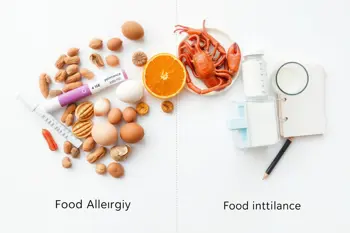
| Feature | Food Allergy | Food Intolerance |
|---|---|---|
| System Involved | Immune system (IgE antibodies) | Digestive system (enzyme or chemical reaction) |
| Onset of Symptoms | Minutes to 2 hours after exposure | Hours to days after consumption |
| Typical Symptoms | Hives, swelling, wheezing, vomiting, anaphylaxis | Bloating, gas, abdominal pain, diarrhea |
| Severity | Mild to life-threatening | Uncomfortable but rarely dangerous |
| Minimum Trigger Amount | Even trace amounts can cause severe reactions | Often dose-dependent; small amounts may be tolerated |
| Emergency Risk | Yes, anaphylaxis is possible | No anaphylaxis risk |
It is also worth noting that non-IgE mediated food allergies exist, such as Food Protein-Induced Enterocolitis Syndrome (FPIES). This condition involves a delayed immune response affecting the gut but without the IgE antibody mechanism, and it can cause significant vomiting and diarrhea after eating a trigger food. 11 FPIES demonstrates that the allergy-intolerance spectrum is not always straightforward, reinforcing the importance of formal clinical evaluation rather than self-diagnosis.
Diagnosis: What the Testing Landscape Looks Like
Accurate diagnosis is essential and cannot be reliably achieved through home testing kits or self-reported elimination trials alone. For food allergies, diagnosis relies heavily on patient history, skin-prick tests, and blood tests measuring food-specific IgE levels. John Leung, MD, adjunct associate professor at the Friedman School of Nutrition Science and Policy at Tufts University, cautions that many online direct-to-consumer allergy tests are costly and lack scientific validity. 4 Oral food challenges conducted under medical supervision remain the most definitive diagnostic method for confirming or ruling out a true allergy.
For food intolerances, diagnosis typically involves structured elimination diets, symptom diaries, and in some cases specific enzyme tests such as hydrogen breath tests for lactose intolerance. 6 These approaches require patience and professional guidance to avoid nutritional deficiencies during the elimination phase. An allergist or gastroenterologist is the appropriate specialist for evaluation, depending on whether an immune-mediated or digestive mechanism is suspected. 12
Management Strategies and Key Risks
The management frameworks for the two conditions differ substantially. Food allergy management requires strict avoidance of the allergen and emergency preparedness. Dr. Michael D'Netto, a Mayo Clinic Health System board-certified allergist and immunologist, states that patients with a history of food allergies should carry an epinephrine auto-injector such as an EpiPen at all times. 13 Emerging therapies, including oral immunotherapy and biologic medications, are expanding treatment options for selected allergens, though these require close medical supervision. Accurate diagnosis through clinical history, skin prick testing, and serum-specific IgE measurement remains foundational to management. 14
Food intolerance management, in contrast, centers on dietary adjustments and, where applicable, enzyme supplementation. For lactose intolerance, over-the-counter lactase enzyme supplements can allow consumption of dairy without symptoms. Keeping a detailed food diary helps identify trigger foods and portion thresholds. 5 While intolerances are not medically dangerous in the same way as allergies, untreated chronic gut irritation linked to intolerances has been associated with intestinal inflammation and gut dysbiosis, an imbalance of gut bacteria that researchers have linked to inflammatory bowel diseases and autoimmune disorders. 7 This reinforces that neither condition should be dismissed without proper evaluation and management.
Sources
- Mayo Clinic - Food Allergy vs. Food Intolerance: mayoclinic.org
- UK Food Intolerance - Food Intolerance vs Allergy: Spot the Difference: ukfoodintolerance.co.uk
- UTMB Health News - Food Allergy vs. Food Intolerance: What's the Difference?: utmb.edu
- Tufts Now / MedicalXpress - How to Tell if You Have a Food Allergy or Intolerance: now.tufts.edu
- Johns Hopkins Medicine - Food Allergy vs. Food Intolerance: hopkinsmedicine.org
- American College of Allergy, Asthma and Immunology - Food Allergy vs. Intolerance: acaai.org
- Atma Clinic - Demystifying Food Allergies vs Intolerances vs Sensitivities: atmaclinic.com
- Westchester Park Pediatrics - Food Allergies vs. Sensitivities: What Parents Should Know: westchesterparkpediatrics.com
- Urgent Care Family / Cleveland Clinic - The Nine Major Food Allergens: urgentcarefamily.com
- Grub Allergy - Food Allergy vs. Intolerance: Key Differences Explained: gruballergy.com
- NIAID - Food Protein-Induced Enterocolitis Syndrome (FPIES): niaid.nih.gov
- FoodAllergy.World - IgE or Non-IgE or Food Intolerance: foodallergy.world
- WinnMed - Food Allergy vs. Food Intolerance: What's the Difference?: winnmed.org
- NCBI StatPearls - Food Allergies: ncbi.nlm.nih.gov
Authored by MyTrendSpot team