Hair Loss Symptoms and Treatments: A Clinical Guide to Causes, Diagnosis, and Evidence-Based Interventions
Hair loss, medically termed alopecia, is one of the most frequently reported dermatological concerns worldwide. It is estimated that 85% of males and 33% of females will experience some form of hair loss during their lifetime, and approximately 25% of males and 12% of females will begin to lose hair by the age of 30. 1 The condition ranges from normal daily shedding to progressive, permanent follicle miniaturization, and recognizing the difference between these presentations is the foundation of effective clinical management.
Recognizing the Core Symptoms of Hair Loss
Hair loss can manifest in several distinct patterns, and the specific presentation often provides the first diagnostic clue. The most common symptom is gradual thinning on top of the head, which affects men as a receding hairline at the forehead and women as a broadening of the part. 2 An increasingly recognized pattern in older women is frontal fibrosing alopecia, a form of receding hairline linked to chronic scalp inflammation.
Other symptomatic presentations include circular or patchy bald spots on the scalp, beard, or eyebrows; sudden loosening of hair across the entire scalp; and full-body hair loss. 2 Associated scalp symptoms such as redness, itching, burning, tenderness, or scaling can accompany inflammatory or autoimmune forms of the condition. Penn Medicine notes that changes in hair texture, brittle nails, fatigue, and pitted nails may appear alongside alopecia when an underlying systemic condition is responsible. 3 Losing around 100 hairs per day is considered within the normal range as part of the hair growth cycle; shedding that consistently exceeds this threshold warrants clinical evaluation.
Major Types and Their Underlying Causes
Androgenetic alopecia is the most prevalent form of hair loss in both sexes. About 95% of males who experience hair loss do so due to this inherited condition. 1 It results from genetic sensitivity of scalp follicles to the androgen dihydrotestosterone (DHT), which causes follicles to progressively shrink and produce thinner, shorter hairs until growth stops entirely. Pattern hair loss affects roughly 50% of men by age 50 and about 80% by age 70, while around 19% of women are affected, with prevalence rising sharply after menopause. 4 A 2026 review in the American Journal of Clinical Dermatology confirmed that androgenetic alopecia affects nearly 50% of women during their lifetime, yet remains underdiagnosed and undertreated in female populations. 5
Telogen effluvium is a second major category, characterized by diffuse shedding triggered when physical or psychological stress forces a large proportion of follicles into the resting (telogen) phase simultaneously. Normally, approximately 15% of scalp follicles are in the shedding phase at any time; in telogen effluvium, this increases to 30% or more, and the shedding surge typically occurs around three months after the triggering event. 6 Common triggers include childbirth, severe illness or surgery, rapid weight changes, and major psychological stress. Alopecia areata, an autoimmune condition in which the immune system attacks hair follicles, affects an estimated 7 million people in the United States and typically produces patchy circular bald spots. 1 In advanced cases, it may progress to alopecia totalis (complete scalp hair loss) or alopecia universalis (full-body hair loss).
Diagnostic Methods Used in Clinical Practice
Accurate diagnosis requires more than a visual inspection. Clinicians typically begin with a thorough medical history covering diet, hair care habits, medications, family history, and recent stressors. A physical examination evaluates the location and pattern of loss, scalp appearance, and follicle markings. Mayo Clinic outlines four standard diagnostic tests used to characterize hair loss more precisely. 2
| Diagnostic Test | Purpose |
|---|---|
| Blood Test | Identifies underlying medical causes such as thyroid dysfunction, iron deficiency, or hormonal imbalances |
| Pull Test | Gently extracts several dozen hairs to assess the stage and severity of the shedding process |
| Scalp Biopsy | Examines hair roots microscopically to identify infections or inflammatory conditions affecting follicles |
| Light Microscopy (Dermoscopy) | Uses a specialized instrument to examine hairs at their bases and detect disorders of the hair shaft |
VCU Health dermatologist Kimberly Salkey, MD, notes that dermatologists evaluate specific features including the location of loss, whether it is diffuse or localized, the scalp appearance in affected areas, and whether follicle markings are present or absent. 7 These distinctions are critical because different types of alopecia can look similar to an untrained observer yet require entirely different treatment strategies.
FDA-Approved Medications and Off-Label Pharmacological Options
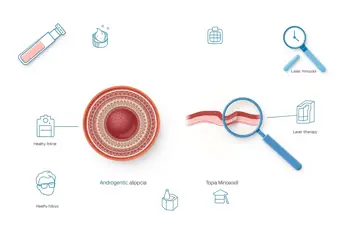
The only treatments with FDA approval for proven efficacy are topical minoxidil, indicated for both men and women, and oral finasteride, indicated for men only. 4 Minoxidil, sold over the counter in liquid, foam, and shampoo formulations, is applied once daily for women and twice daily for men. It slows shedding and can stimulate regrowth in approximately 40 to 60% of users within roughly six months, though benefits cease once treatment is discontinued, making it an ongoing rather than curative therapy. 4 Finasteride works by blocking the conversion of testosterone to DHT; Harvard Medical School notes that about 20% of men start balding by age 20 and about 30% do so by age 30, making early pharmacological intervention a clinically relevant consideration for many patients. 8
Off-label pharmacological approaches are also used in clinical practice. These include low-dose oral minoxidil for patients in whom topical application is insufficient or poorly tolerated, as well as anti-androgens such as spironolactone and 5-alpha reductase inhibitors (finasteride and dutasteride) for women with androgenetic alopecia. 5 Combination therapy using finasteride, minoxidil, and ketoconazole has demonstrated greater efficacy than any single agent alone, and adding low-level laser therapy or microneedling to a medication regimen has shown substantive increases in hair count in clinical studies. 9 Corticosteroid injections into affected areas are a standard approach for alopecia areata, though they require frequent repetition to maintain effect.
Procedural and Surgical Treatment Options
For individuals with stable, well-defined patterns of hair loss and adequate donor density, hair transplant surgery represents the primary surgical intervention. The procedure involves transferring androgen-resistant follicular units from the occipital scalp to thinning or bald areas, using either follicular unit transplantation (FUT) or follicular unit extraction (FUE). StatPearls notes that ideal candidates have healthy scalps, realistic expectations about coverage, and stable hair loss patterns. 10 Scarring alopecia, where follicle damage is irreversible, generally represents a contraindication to transplantation in affected zones.
Low-level laser therapy (LLLT) represents a non-invasive procedural option with a growing evidence base. Devices cleared for this purpose deliver specific wavelengths of light to the scalp to stimulate follicular activity. Clinical evidence supports its use as a supplementary approach in androgenetic alopecia, and the National Health Service includes it among recognized management options. 11 Platelet-rich plasma (PRP) therapy, which involves injecting concentrated growth factors from the patient's own blood into the scalp, is also used as an adjunct treatment. It is important to note that no procedural option guarantees full restoration, and outcomes vary based on the degree and type of loss, patient age, and the underlying cause.
When to Seek Professional Evaluation and Known Risks
Certain presentations should prompt timely dermatological assessment rather than self-directed management. These include sudden diffuse shedding across the entire scalp within a short timeframe, patchy circular bald spots, scalp scaling or burning accompanying hair loss, and shedding that follows recent illness or significant stress. 12 Hair loss combined with fatigue, weight changes, or nail abnormalities may indicate a systemic condition requiring separate investigation and treatment before hair-specific therapy can be effective.
All pharmacological treatments carry recognized risks and limitations that patients should discuss with a qualified clinician. Finasteride carries a small but documented risk of sexual side effects in men. Minoxidil can cause scalp irritation and, in some cases, paradoxical initial shedding when first started. Surgical hair restoration carries standard surgical risks including infection, scarring, and suboptimal graft survival. A meta-analysis cited in the Canadian Diabetes and Endocrinology Today found that androgenetic alopecia is associated with moderate impairment in health-related quality of life and emotional well-being, underscoring the importance of addressing both the clinical and psychosocial dimensions of the condition. 13 Nutritional contributions to hair loss, including deficiencies in iron, zinc, selenium, and vitamins A, B, C, and D, can be identified through targeted blood testing and corrected before pharmacological therapy is initiated.
Sources
- Healthline - Most Effective Hair Loss Treatments In 2026, According to Experts (healthline.com)
- Mayo Clinic - Hair Loss: Symptoms and Causes (mayoclinic.org)
- Penn Medicine - Hair Loss (Alopecia): Symptoms and Causes (pennmedicine.org)
- HealthVetted - Hair Loss: Symptoms, Causes and Treatment 2026 (healthvetted.com)
- American Journal of Clinical Dermatology via Springer Nature - Androgenetic Alopecia in Women: A Narrative Review (link.springer.com)
- British Association of Dermatologists - Telogen Effluvium Patient Information Leaflet (bad.org.uk)
- VCU Health - A Dermatologist's Guide to Hair Loss Treatments (vcuhealth.org)
- Harvard Health - Treating Hair Loss in Men: What Works? (health.harvard.edu)
- Wikipedia - Management of Hair Loss (en.wikipedia.org)
- StatPearls / NCBI Bookshelf - Hair Transplantation (ncbi.nlm.nih.gov)
- National Health Service (NHS) - Hair Loss (nhs.uk)
- Gulf Coast Hair Restoration - Is My Hair Loss Normal or a Medical Problem? (gulfcoasthairrestoration.com)
- Canadian Diabetes and Endocrinology Today - Androgenetic Alopecia: Pathogenesis, Evaluation, and Management (canadiandiabetesandendocrinologytoday.com)
Authored by MyTrendSpot team